Worshipped by followers as God, and by others in the tradition as a manifestation of Krishna. The Supreme Court of India in 1966 described him as a Hindu saint.
Discourses dated in his lifetime, a surviving presentation manuscript, and first-hand testimony by a hostile-in-doctrine bishop. His youth rests on sect tradition.
Vachanamrut, first dated discourse 21 November 1819 (written 11 years before their death)
Paper trail
Where they came from
Chhapaiya, Gonda district, Uttar Pradesh, India (then under the Nawab of Oudh) (traditional)
Gujarat and Kathiawar, 1799 to 1830
Cremated at Lakshmi Wadi, Gadhada, Gujarat; the site and the temple there are pilgrimage places
Father Hariprasad Pande (Dharmadev) and mother Premvati (Bhaktimata), Brahmins. Brothers Rampratap and Ichcharam. The Supreme Court gave 'about the year 1780'.
Seven years as a wandering ascetic, known only from sect tradition. Ramanand Swami initiated him in 1800. Followers treat the journey as his formation.
His parents' deaths precede his departure, in sect tradition. He worked in a region of banditry and weak authority, as British officers said to Heber.
Ramanand Swami named him successor. Followers called him God in his lifetime, and Heber recorded a hint of this in 1825. British officials then noticed him as a force for order.
Life
Ghanshyam Pande was born at Chhapaiya, near Ayodhya, to the Brahmins Hariprasad and Premvati. After his parents died he left home at eleven in 1792 and travelled for about seven years as the ascetic Nilkanth Varni. He reached Loj in Gujarat in 1799, received initiation from Ramanand Swami in 1800 under the name Sahajanand Swami, and succeeded him about 1802, an appointment that led some followers to leave.
He preached strict morals and devotion across Gujarat and Kathiawar. Temples followed, the first at Ahmedabad in 1822 on land granted by the East India Company government. British officers valued his influence on order. The Collector of Kaira, Mr Williamson, told Bishop Reginald Heber in March 1825 that formerly lawless districts had become orderly. Heber met him at Nadiad, and left a remarkable account.
Discourses from 21 November 1819 onward were written down by his followers as the Vachanamrut. He composed the Shikshapatri in 1826 at Vadtal and presented a copy to Sir John Malcolm, Governor of Bombay, at Rajkot on 26 February 1830.
He died at Gadhada on 1 June 1830 and was cremated there. He had divided his following into two dioceses under acharyas. Later schisms produced the BAPS and other branches.
the idea of two religious teachers meeting at the head of little armies
a middle-sized, thin, and plain-looking person, about my own age, with a mild and diffident expression of countenance
I have thought less favourably of his simplicity and honesty of character
Images
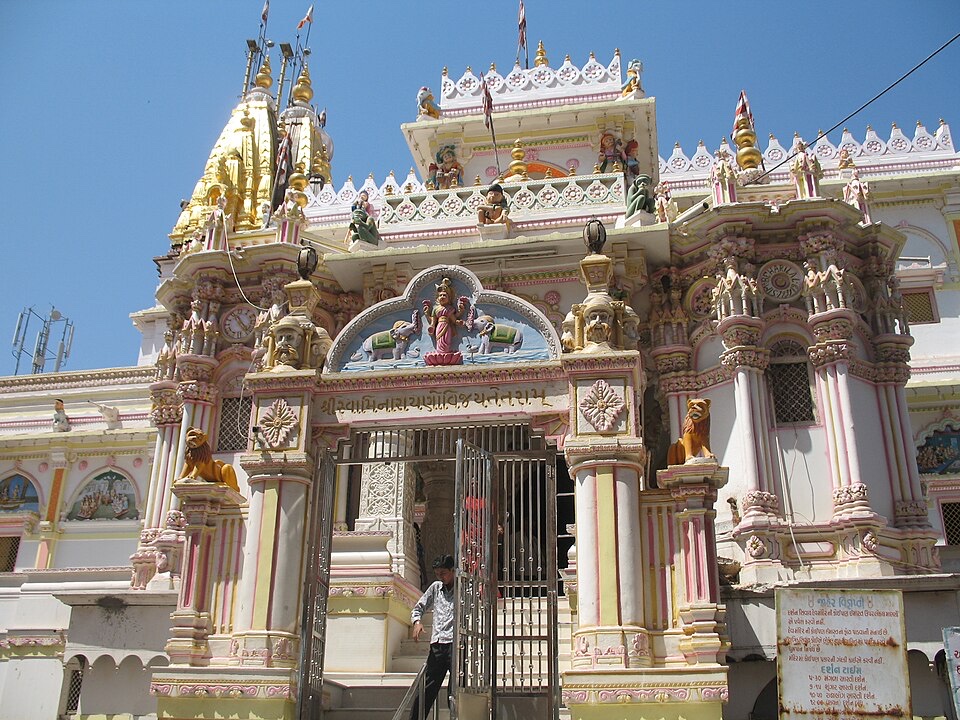
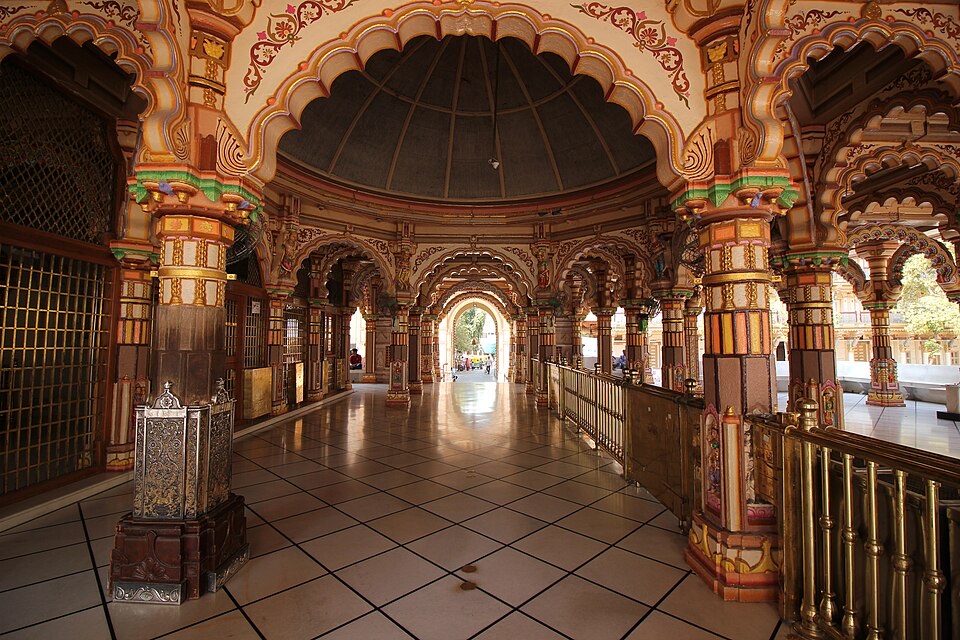
No portrait from life was confirmed. Heber saw a picture of Krishna, not of him. Images here are his temples and a manuscript. Devotional portraits on Commons carry licences that could not be checked against their real age.
Reported events
Lawless villages made orderly
The Collector of Kaira told Heber that villages that accepted the preacher had gone from among the worst to the best and most orderly in the province. Heber adds he was said to have condemned theft and bloodshed and broken the yoke of caste.
those villages and districts, which had received him, from being among the worst, were now among the best and most orderly in the provinces.
Reported by Mr Williamson, East India Company Collector, reported by Bishop Heber; Mr Ironside, who knew him well. Recorded Heber's journal, March 1825; published 1828.
An outside official's statement made in his lifetime. Heber himself qualified it when he found the sect still used images and observed caste in practice. Williamson had an interest in order, and Heber hoped for a preparer of the Gospel. A rare miracle-free claim that can be judged by records.
An outside official's statement in his lifetime, recorded by Heber in 1825. It is one man's judgment, with revenue records unseen, and other causes are possible. Reviewer's judgment, not a calculation.
A hint that he was an avatar
In conversation through imperfect Hindustani, Heber understood him to say there had been many avatars and to hint at another in himself. He reports 5,000 disciples nearby and nearly 50,000 in Gujarat, on Swaminarayan's own word.
adding something like a hint, that another avatar of Krishna, or the Sun, had taken place in himself.
Reported by Bishop Reginald Heber, hostile in doctrine but respectful, first-hand. Recorded 1825.
A rare outside record of how he spoke of himself. Heber admits his language failed him at times, and writes 'if we understood him right'. It agrees broadly with the sect's later belief.
A first-hand journal by a doctrinal opponent, written close to the event. Heber himself says his Hindustani may have failed him. Reviewer's judgment, not a calculation.
Story of the fakir and Kashi
A short notice in the Indian Antiquary for 1872 retells a miracle story of a fakir and Kashi among followers of Swami Narayan.
Reported by Unnamed writer in the Indian Antiquary, drawing on local tradition. Recorded 1872.
Read only in an imperfect OCR text, and worth checking against a scan before use. Shows that miracle stories circulated within two generations. Sect literature holds a large stock of such stories that were not reviewed here.
An unnamed writer retells local tradition 42 years after his death, read only in imperfect OCR. The card does not say what the wonder was. Reviewer's judgment, not a calculation.
Sources: Narayan Swami (note)
Departure for Akshardham
Followers hold that at death he returned to his divine abode, Akshardham, and that he remains present in the sect's temples and its succession of holy persons.
Reported by Sampraday tradition, summarised by Raymond Williams through the reference source. Recorded Tradition, date of first record not traced here.
A theological claim that history cannot test. The death at Gadhada in 1830 is not in doubt.
Event scored: that followers hold this belief, not that it is so. The death at Gadhada is not in doubt and there is no event to test. Known here only through a summary, so lowered by about 10. Reviewer's judgment, not a calculation.
Sources: Swaminarayan
Disputes
- Heber records that he arrived with near 200 horsemen, armed with matchlocks and swords, plus men on foot. The holy man's armed escort is a startling image in view of his teaching against bloodshed.
- Heber received a petition in good English signed by him in Nagri, asking for an endowment for a temple and a pilgrim hospital. Heber refused to help with the temple, as a Christian, but offered to convey the charitable part to Mr Elphinstone. The petition has not been found.
- Heber heard from Mr Ironside that Swaminarayan privately doubted images but kept them for the sake of ignorant people. Heber thought less of him for it. The sect would reject the report.
- Reference sources record criticism from Dayananda Saraswati and a 1918 letter of Gandhi. These were not read here.
- In Sastri Yagnapurushadji v. Muldas Bhudardas Vaishya (1966) the Satsangis argued they were not Hindus, to avoid the Bombay Harijan Temple Entry Act. The Supreme Court dismissed the appeal and held the sect part of Hinduism.
- The succession and schisms: splits at his own succession from Ramanand, and later BAPS (1905) and Maninagar branches, dispute who holds his authority and how his status should be understood.
Still unknown
- Heber's date. Sect sources give 'Sunday, 26 March 1825', but 26 March 1825 was a Saturday. Heber's edition should be read in its full context.
- The petition sent to Heber and any report he made to Mountstuart Elphinstone. Try Maharashtra State Archives and India Office Records.
- Malcolm's own record of the Rajkot meeting. We found no primary text, and sources differ between 20 and 26 February 1830.
- The shelfmark of the Bodleian Shikshapatri. It was not confirmed, and sources differ on whether it dates from 1830 or 1831.
- The earliest surviving manuscripts of the Vachanamrut. The text in use derives from an edition of 1928 according to one translator's preface.
Records
Sources
primary
contemporary
scholarly
reference