Glorified as a saint by the Russian Orthodox Church, 19 July 1903 (O.S.).
Sources are monastic and devotional, largely written decades later, but the 1903 church acts are solid contemporary documents. No confirmed writing in his own hand beyond a reproduced signature.
Motovilov's note dated 1834, reported by Strizhev; earliest printed life listed by Chichagov is the Skazaniya of 1849 (1 years after death)
Paper trail
Where they came from
Kursk, Russia (documented)
Sarov and Diveyevo, Nizhny Novgorod region (historically Tambov Governorate)
Relics at Diveyevo convent, still a major pilgrimage. Hidden in Soviet years and recovered in 1991.
Merchant family of Kursk. His father Isidore is said to have died while building a cathedral, a detail from tradition. His mother Agathia raised him.
Monastic formation at Sarov. Followers point to a bell tower fall at seven and a healing vision as turning points; both come from hagiography.
Serious illness and a violent robbery are recorded in the tradition. He also faced friction inside Sarov, per later Diveyevo narratives.
Visitors to his cell from 1825, then Diveyevo sisters, Motovilov's notes and printed lives. Chichagov's Diveyevo Chronicle (1896, 1903) and Nicholas II's support turned this into formal canonization.
Life
Prokhor Moshnin was the son of a Kursk merchant family. Dates in the sources vary between 1754 and 1759. He entered Sarov monastery as a novice on 20 November 1778, was tonsured Seraphim on 13 August 1786 and became a hieromonk in 1793, according to the Russian Biographical Dictionary.
He withdrew to a forest hut, where tradition describes long fasts and prayer on a stone. Robbers beat him and left him bent for life; the tradition says he pleaded for them. He then lived in silence and in enclosure in the monastery, and from 25 November 1825 he received visitors.
In his last years he took an interest in the women's community at Diveyevo, which later became a major monastery and the source of much of his legend. He died on 2 January 1833. Popular veneration grew through the century.
In 1903 the Holy Synod canonized him at a huge ceremony at Sarov, attended by Nicholas II. Richard Price has studied the strange circumstances and the politics behind it. In the same year Sergei Nilus published the famous 'Conversation with Motovilov', whose authenticity remains disputed.
The body of the ever-memorable elder Father Seraphim had given way to decay.
Images
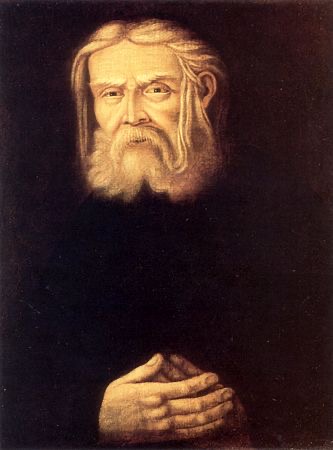
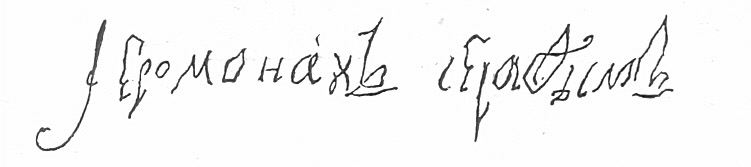
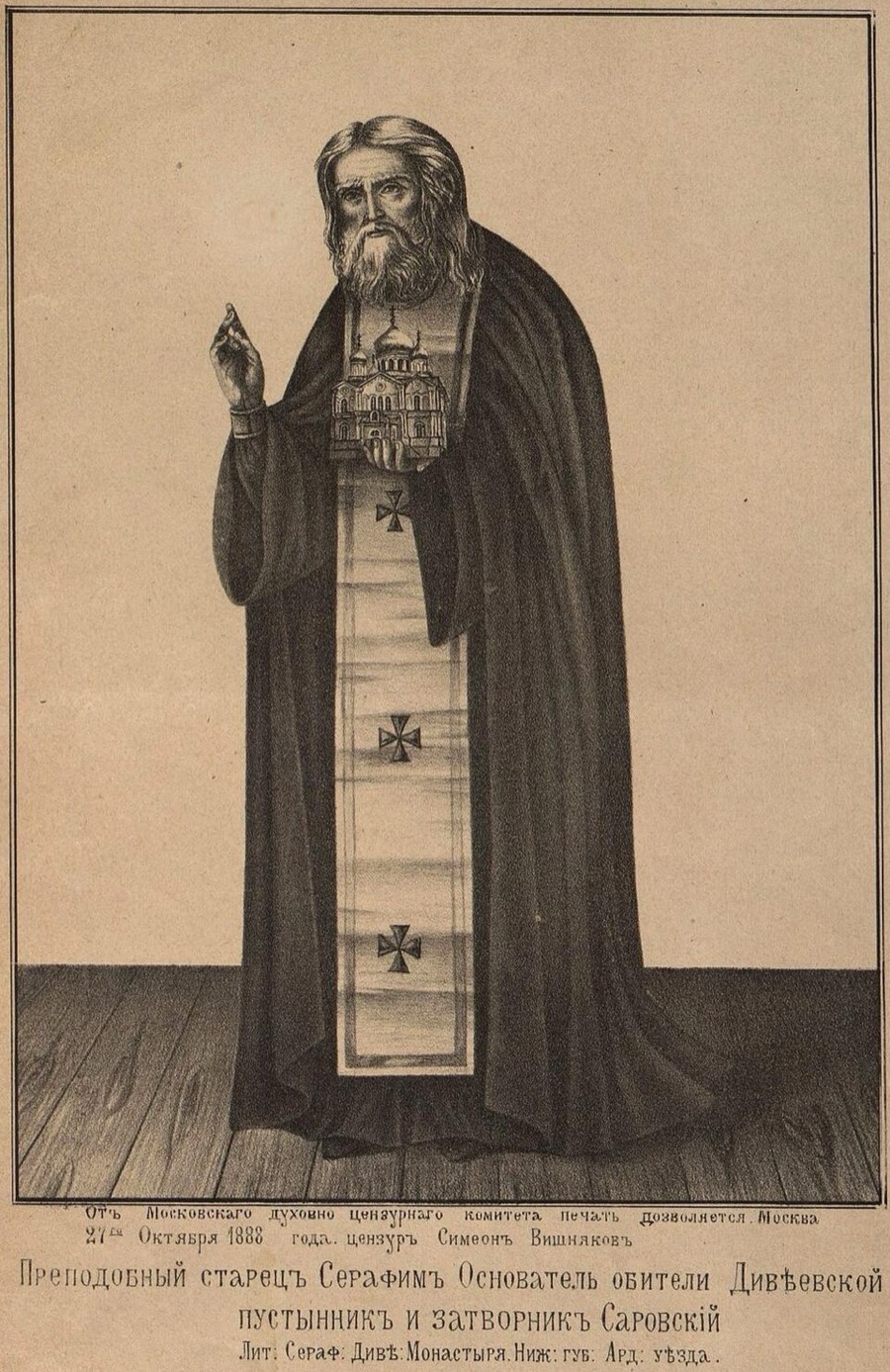
Reported events
The shining face in the snow
Nikolai Motovilov wrote that in November 1831, in the forest near Sarov, Seraphim's face shone brighter than the sun during their talk about acquiring the Holy Spirit.
Imagine: in the middle of the sun, in the most dazzling brightness of its noon rays, the face of a man talking with you.
Reported by Nikolai Motovilov, a young landowner and disciple. Recorded Date of writing unknown; published by Sergei Nilus in 1903, 70 years after Seraphim's death.
The single source is Motovilov's manuscript as published by Nilus, who also published the forged Protocols of the Elders of Zion and said he could read the manuscript only after prayer. An anonymous critical essay on the Mystagogy blog and Alexander Strizhev both treat Motovilov as an unreliable witness, Strizhev chiefly on prophecies. Nilus cut some pages in 1905 after criticism. The original manuscript's whereabouts were not found. The text is nevertheless a classic of Orthodox spirituality, whatever its exact origin.
A named witness, but known only through Nilus's edition of 1903, 72 years on, with the manuscript missing and the source doubted. A sole account at the bottom of the band. Reviewer's judgment, not a calculation.
Sources: Seraphim of Sarov; What St. Seraphim of Sarov Didn't Say; The Authenticity of the Conversation of Saint Seraphim with Motovilov; Stiazhanie Dukha Sviatogo (compilation including the Conversation and Nilus's afterwords of 1903 and 1911)
The grave opened: no incorrupt body
An official commission opened the grave on 11 January 1903 and recorded that the body had decayed, leaving bones, hair, and remains of the monastic habit.
The body of the ever-memorable elder Father Seraphim had given way to decay.
Reported by Commission under Metropolitan Vladimir of Moscow, with Bishop Dimitry of Tambov, Bishop Nazary and others. Recorded 11 January 1903, printed in the same year.
This is the firmest physical record in his file, and it runs against the popular belief that a saint's body should not decay. The 1903 church press argued that sanctity rests on miracles, not incorruption. A preliminary examination by Bishop Dimitry had taken place in August 1902.
A signed official act made at the opening and printed the same year, against the interest of those who made it. It records bones and normal decay. Reviewer's judgment, not a calculation.
Healings at the 1903 festivities
The 1903 church press lists cures at the spring and relics at Sarov: a mute boy speaking, a blind woman seeing, a man discarding his crutch, and about fifteen crutches burned on the bank of the Sarovka. It also cites 94 healings investigated and verified for the canonization.
the 94 miraculous healings examined and certified with all care
Reported by Metropolitan Antony's report and writers in Missionerskoe Obozrenie. Recorded July 1903, within days.
The reports are contemporary, but they come from the institution staging the canonization, in a crowd of hundreds of thousands of very sick pilgrims. Named patients are few in the pages I read. A Russian account reports that only part of the proposed miracles was accepted; We did not confirm that from an original source.
Reports printed within days, but from the body staging the canonization. Named patients are few and the 94 case files were not seen. Reviewer's judgment, not a calculation.
Prophecies about Russia
Later collections attribute to him prophecies about the tsars, Antichrist and Russia's fate.
Reported by Motovilov's notes, Diveyevo traditions, Nilus and later compilers. Recorded Mostly first printed in the 20th century; one Motovilov note is dated 1834.
Alexander Strizhev argues that most are unreliable and that one passage alone is marked by Motovilov as Seraphim's words, the rest being his own reflections. 'The Great Diveyevo Mystery' first appeared in 1969 in San Francisco.
One note of 1834 aside, these appear in print generations later, and Strizhev finds most of them unreliable. Composition after the events is the leading candidate. Reviewer's judgment, not a calculation.
Sources: What St. Seraphim of Sarov Didn't Say; The Canonization of Serafim of Sarov: Piety, Prophecy and Politics in Late Imperial Russia
Disputes
- Price writes of the strange circumstances of the canonization and of the court's interest in the cult. The Tsar's personal role is widely reported, but we could read only the extract of Price and not the Synod papers.
- The 1903 finding that the body had decayed was a public embarrassment, and an anonymous pamphlet campaign demanded the coffin be opened, as Missionerskoe Obozrenie itself reports.
- Sergei Nilus, the publisher of the Conversation with Motovilov, also published the antisemitic forgery known as the Protocols of the Elders of Zion.
- Motovilov was arrested in 1832 on charges he said were fabricated; he was released in 1833 by order of Nicholas I. One critic reports that he suffered from mental illness.
Still unknown
- Where Motovilov's original manuscripts are now. The Russian State Archives and Diveyevo should be asked.
- The first edition of the earliest printed life. Chichagov's preface lists an 1849 Skazaniya; reference works mention a Skazanie by Archimandrite Sergii, and we could not settle how they relate.
- The Synod's file on the 94 healings, probably in the Russian State Historical Archive (RGIA); shelfmark not confirmed.
- The exact date of first printing of the Conversation: sources give May or July 1903.
Records
Sources
primary
hagiography
scholarly
reference