Followers regard him as an avatar and as the reincarnation of Sai Baba of Shirdi. Estimates of followers range from about 6 million to 100 million. He was never charged with a crime.
Modern press, film, court filings, police reports, trust statements and eyewitness investigators exist in quantity. What they establish is contested, and the key official files have not been opened to the public.
Kasturi, Sathyam Sivam Sundaram, Part I (1960) (written 51 years before their death)
Paper trail
Where they came from
Puttaparthi, Sri Sathya Sai district (then Anantapur), Andhra Pradesh, India (Madras Presidency) (documented)
Puttaparthi throughout; also Whitefield, Bangalore
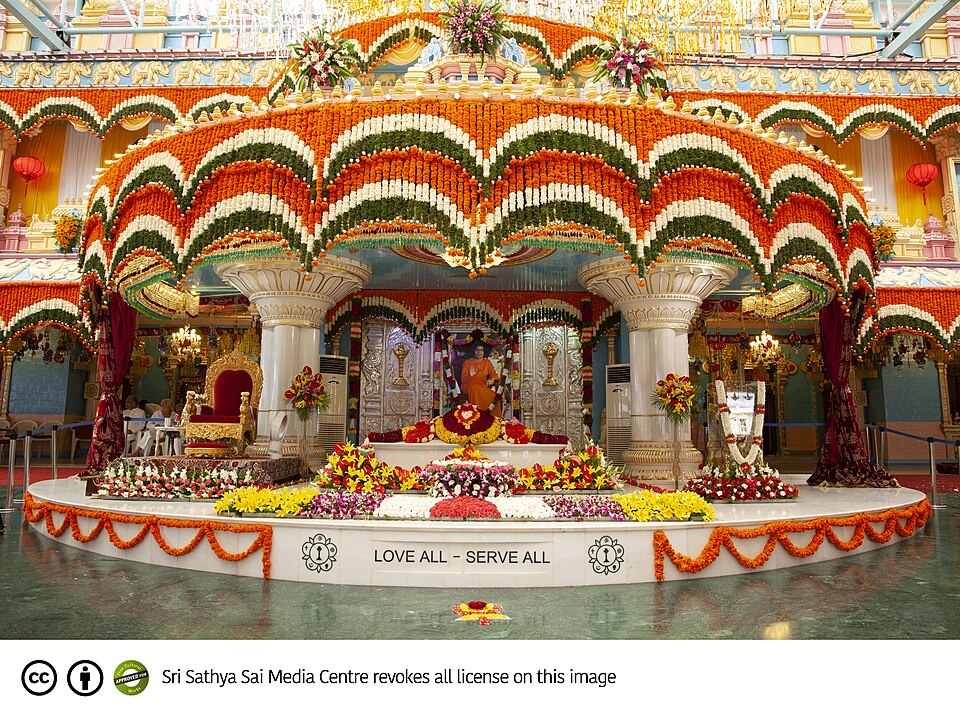
Mahasamadhi shrine, Sai Kulwant Hall, Prasanthi Nilayam; visited daily
Mother Easwaramma; elder brother Seshama, who took him to Kamalapuram for school. Village family; surname given as Ratnakaram Raju in reference sources. No known religious lineage.
No teacher. Followers point to his declaration of 1940. The devotional account of an illness or scorpion sting before the declaration was not confirmed in any primary source opened, and the critic's blog disputes its timing against school registers.
A declared break with school at about fourteen. No other crisis is well documented.
He declared himself. Local villagers and then wealthy patrons accepted him, and Kasturi, who met him in 1948, wrote the official life and edited the movement's magazine. Babb argues that the miraculous drove the growth of the movement.
Life
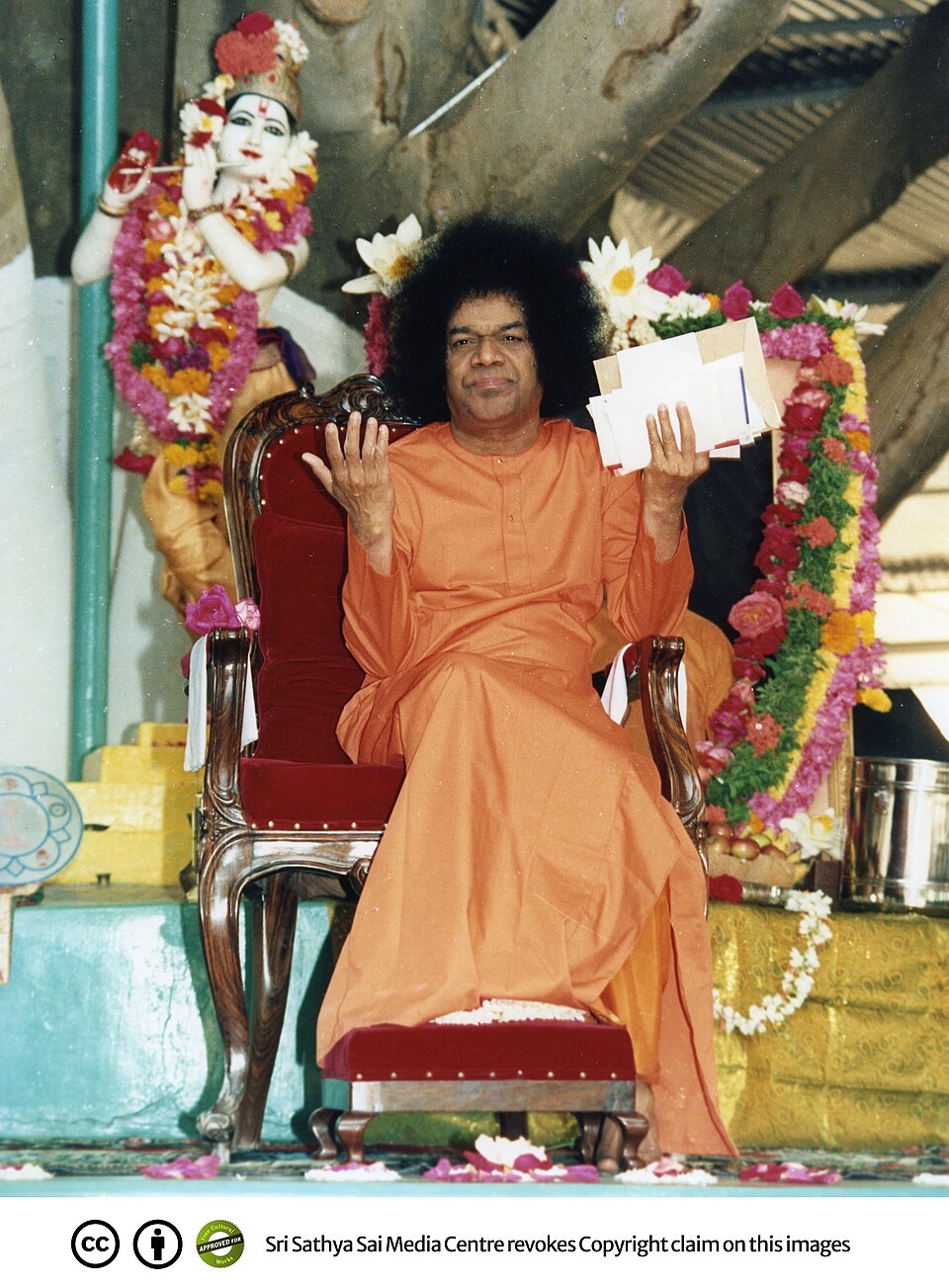
Sathyanarayana Raju was born in Puttaparthi, then a small village in Andhra. His movement gives the date as 23 November 1926. He went to school at Kamalapuram, Bukkapatnam and Uravakonda, and at about fourteen, in 1940, announced that he was Sai Baba of Shirdi returned. The official biography, Narayana Kasturi's Sathyam Sivam Sundaram, first appeared in 1960 and is hagiography.
His ashram Prasanthi Nilayam grew around Puttaparthi, and he became known for producing sacred ash (vibhuti), rings and watches, apparently from the air. Prime ministers and presidents visited. The movement built schools, a university and large free hospitals, with a reported 2,560 overseas centres by 2000 according to India Today.
From the 1970s rationalists led by Basava Premanand charged sleight of hand. From about 2000 former devotees accused him of sexually abusing boys and young men. Four intruders and two attendants died at his residence in June 1993. No court ever tried him on any of these matters, and he and his organisations rejected the charges.
He was hospitalised on 28 March 2011 and died on 24 April. Inventories of his private rooms in June and July, and a police cash seizure, drew national attention.
Images
Reported events
Vibhuti and objects produced from the air
Followers report that he produced ash, jewellery and sweets from an open hand. Erlendur Haraldsson and Karlis Osis watched this during visits in 1973 and 1974 and interviewed witnesses. A jeweller examined one gold and ruby ornament and found it genuine.
Reported by Devotees widely; Haraldsson and Osis, parapsychologists; Kasturi, official biographer. Recorded Haraldsson and Osis, Journal of the American Society for Psychical Research 71 (1977).
That he appeared to produce objects is not in doubt, and thousands saw it. Whether this was sleight of hand is the issue. He declined controlled tests. Neither investigator was a skilled magician, as a sympathetic review admits. Premanand and others reproduced similar effects. Dale Beyerstein's 1994 study argues for conjuring.
Named investigators report what they watched within about three years, and that he appeared to produce objects is not in doubt. Scored is production from nothing: he declined controlled tests and the effects have been reproduced by conjurors. Known here only through a summary, so lowered by about 10. Reviewer's judgment, not a calculation.
Sources: Sai Baba; Sathya Sai Baba movement; Basava Premanand
The stone that vanished from a ring
Haraldsson reports that a ring Sai Baba gave Osis in 1973 lost its stone while the investigators sat with him in 1974, and that the frame showed no damage.
Reported by Erlendur Haraldsson, investigator and first-hand witness. Recorded 1977 paper; retold in his Psi Encyclopedia entry.
A named investigator's own report, written three years on, and the entry's author is the sole source opened here. Nobody examined how the stone was set in advance. A stone can fall from a ring without the wearer noticing.
Scored as a stone going missing, with no claim about why. A named investigator reports it, but nobody checked the setting beforehand, and stones do fall out unnoticed. Known here only through a summary, so lowered by about 10. Reviewer's judgment, not a calculation.
Sources: Sai Baba
The 1992 video of the Prime Minister's visit
On 23 November 1992 the Deccan Chronicle ran a story headed 'DD Tape Unveils Baba Magic', claiming state television footage showed him receiving an item from an aide before producing it for a dignitary.
Though it looks suspicious, it offers no unequivocal evidence of fraud.
Reported by Deccan Chronicle, as cited through Haraldsson; Haraldsson and Richard Wiseman examined the tape. Recorded 23 November 1992.
The closest thing to physical evidence on the question. Haraldsson, a sympathiser, and Wiseman, a sceptical psychologist, reviewed it together, and their conclusion is quoted here. The tape itself was not seen here. The newspaper article was traced only through a citation.
Event scored: that the tape shows an aide passing him the item. Reviewers from both sides judged it suspicious but not conclusive, and the tape was not seen here. Known here only through a summary, so lowered by about 10. Reviewer's judgment, not a calculation.
Sources: Sai Baba; Sathya Sai Baba
Reincarnation of Sai Baba of Shirdi
At about fourteen he announced that he was Sai Baba of Shirdi. The official story places this in 1940. A critic's blog prints school papers showing a birth date of 4 October 1929, one of them altered, and argues he was younger and still enrolled.
Reported by Sathya Sai Baba himself; Kasturi; a pseudonymous former devotee's blog. Recorded Kasturi 1960. School papers dated 1941 to 1943, published online 2006..
Reincarnation cannot be tested. The school papers are worth finding, but the blog is partisan, gives no custody for the originals, and birth dates in Indian school registers of the period are often unreliable. The official date is equally unsupported by any birth register that we could find.
Event scored: that he announced this as a boy, which Kasturi records and his critics do not deny. The date is disputed, and the reincarnation itself is not scored. Reviewer's judgment, not a calculation.
Sources: Description of Sathyam Sivam Sundaram; Sai Baba's School Records: New Light, Part 3; Shootout at Puttaparthi
Appearances at a distance and healings
Haraldsson collected reports of a dream visit that prompted a journey, the healing of a child, and an appearance in Kerala while he was elsewhere.
Reported by Devotees interviewed by Haraldsson. Recorded Interviews from the 1970s, published 1987 onward.
Interviews with believers, mostly about events years earlier, gathered by a friendly investigator. Details were read only in his summary, so names and dates were not checked.
Believers' memories of events years earlier, gathered by a friendly investigator, with names unchecked. No hostile or sworn witness supports it. Known here only through a summary, so lowered by about 10. Reviewer's judgment, not a calculation.
Sources: Sai Baba
Disputes
- Sexual abuse allegations, unproven in any court: former devotees including Conny Larsson, Mark Roche and Alaya Rahm have alleged sexual abuse or advances. David Bailey circulated The Findings around 2000. India Today's 4 December 2000 cover story reported that none of the allegations had been proven and that no accuser had filed a case in India. Sai Baba publicly rejected attackers in December 2000 (Times of India, 26 December 2000, cited at second hand).
- BBC Two's Secret Swami (June 2004, reporter Tanya Datta) aired allegations of sexual abuse by a father and son and interviewed Isaac Tigrett, who is reported to have said there might be substance to the rumours but that it made no difference to his faith. A Danish film preceded it in 2002. Tanya Datta wrote in 2023 that she stands by the investigation.
- Alaya Rahm sued the Sathya Sai Baba Society in California (reported Case No. 05CC01931, filed 6 January 2005) and dismissed the case himself on 7 April 2006, according to a devotee-side article in The Pioneer. It reports no settlement. The case never reached a verdict, so it neither proved nor disproved the allegation.
- The US State Department's consular sheet of 20 May 2004 warned of unconfirmed reports of inappropriate sexual behaviour by a prominent local religious leader at an ashram in Andhra Pradesh. It named no one. DNA relays a Guardian report that officials confirmed this meant Sathya Sai Baba.
- In September 2000 UNESCO withdrew from a conference at Puttaparthi with a media advisory citing concern over allegations involving youths and children. A critic's account documents later UNESCO statements, including that the advisory was removed in a routine site purge. The movement's account differs.
- A December 2001 statement signed by Prime Minister Vajpayee and senior jurists called the charges wild, reckless and concocted, according to reference sources; the original was not seen. A former hospital doctor is reported by The Caravan to have admitted a sexual relationship and later retracted it. The Caravan also reports the Supreme Court dismissed a petition by Hari Sampath in 2001.
- The killings of 6 June 1993: knife-wielding intruders entered his residence, two attendants were stabbed to death, and police shot four men dead after they locked themselves in, claiming self-defence. Outlook calls the attackers long-time devotees. Motive remains unresolved. Reports speak of inquiries against some police and of a case eventually closed. Sai Baba was unhurt. Basava Premanand published Murders in Sai Baba's Bedroom and his writ petitions were dismissed. A retired police chief, V. P. B. Nair, is reported as rejecting the police version.
- Premanand's 1986 case: he marched on Puttaparthi with about 500 volunteers and was arrested, and sued under the Gold Control Act over materialized gold. The case was dismissed, and his appeal failed. Reports differ on court and details.
- After his death, inventories of Yajur Mandir (16 to 17 June 2011) reportedly found Rs 11.56 crore, 98 kg of gold and 307 kg of silver. The Central Trust said in a press release of 28 June 2011 that the valuables came to about Rs 30 crore and that tax of Rs 9.5 crore had been paid. Police seized about Rs 35 lakh from a vehicle, and the Trust denied the money was its own.
- Haraldsson's encyclopedia entry says the abuse allegations lack supporting evidence. Humanists International argued that his political connections gave him unusual immunity from the law. Both are interested parties.
Still unknown
- Court and police files of the 1993 deaths, including any CBI report; the Wikipedia article's reference to such a report has no citation. Try Andhra Pradesh CID and Anantapur police.
- The Andhra Pradesh and Madras High Court files in Premanand's cases.
- The original school registers at Kamalapuram, Bukkapatnam and Uravakonda.
- The Doordarshan tape of the 1992 event.
- Rahm depositions, held by the Orange County Superior Court.
Records
Sources
primary
contemporary
hagiography
reference