Contested case. Rejected as a false messiah by rabbinic Judaism. Followers held him to be the Messiah, and the Donme of Salonika kept that faith for centuries.
Dozens of letters, diaries and consular reports were written while events happened, by supporters and enemies alike. The central facts are secure, while the stories of what happened at Edirne come from hostile or later writers.
Letters of Nathan of Gaza and observers, 1665 (written 11 years before their death)
Paper trail
Where they came from
Izmir, Turkey (Smyrna, Ottoman Empire) (documented)
Smyrna, the Holy Land, Constantinople, Edirne
Ulcinj (Dulcigno), Montenegro, by tradition; the location is not established by any source read here.
Father Mordechai Zevi, per Rycaut a broker to an English merchant. Not from a rabbinic dynasty, by this account.
Rabbinic and kabbalistic study in Smyrna. The turning point is the meeting with Nathan of Gaza, who proclaimed him.
Histories commonly link the movement to the massacres of 1648 and to apocalyptic expectation, a link not checked in the sources read here. Scholem is widely reported to have read his moods as manic-depressive; that reading was not checked in the text.
Nathan of Gaza proclaimed him in 1665. Letters spread the news through the Ottoman, Italian, Dutch, German and Polish communities, with rabbis on both sides.
Life
Sabbatai Zevi was born in Smyrna in 1626. Rycaut says his father Mordechai was a broker for an English merchant, and that the son became a notable student of Jewish learning.
In 1665 Nathan of Gaza proclaimed him Messiah. News moved fast through Jewish communities and Christian observers. In Hamburg, according to a museum history, a Portuguese congregation's board ordered prayers for him; in London, Pepys recorded bets.
The Ottomans held him at Constantinople and at the castle of Abydos, called by believers the Tower of Strength. Brought before Mehmed IV at Edirne, on Baer's date 16 October 1666, he converted to Islam under threat of death.
He lived on as a Muslim with the name Aziz Mehmed Efendi, on an official pension by one recent account, and kept contact with believers. He was exiled to Dulcigno in Albania and died there in 1676. Some believers held that his conversion was a mystery, and one group followed him into Islam and became the Donme.
Everyone here is talking of a report that the Jews, after remaining scattered for more than two thousand years, are about to return to their country.
Images
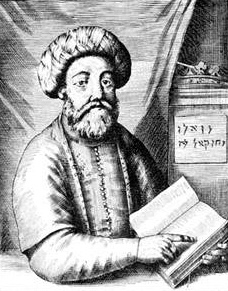
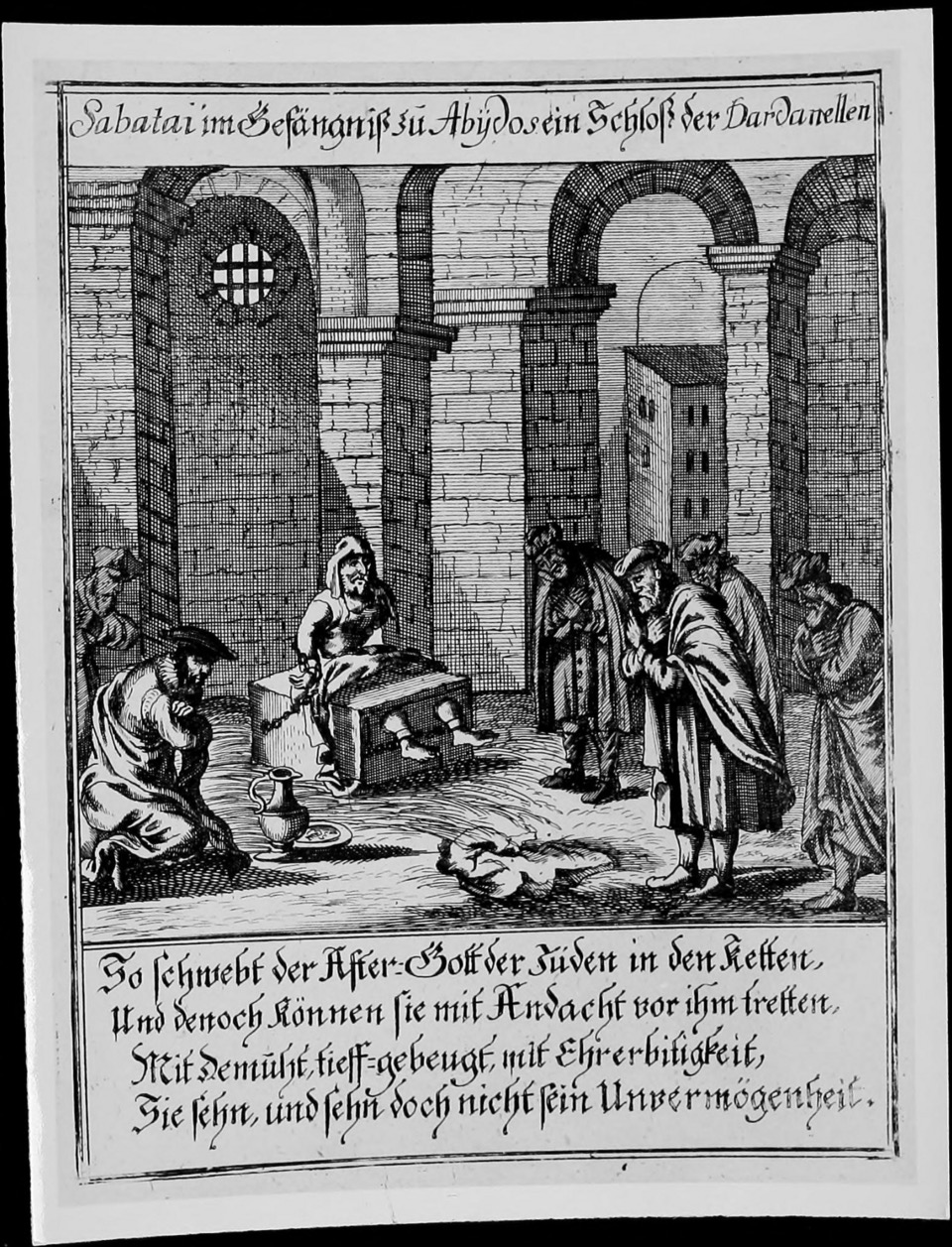
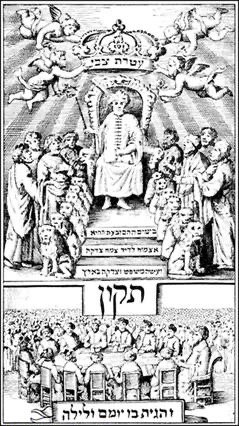
Images 1 and 3 are very small (under 250 px wide) and need better scans for print.
Reported events
Nathan of Gaza's proclamation
Nathan of Gaza proclaimed Sabbatai the Messiah in 1665 and sent letters across the Jewish world. Rycaut prints in English a letter from Nathan to Sabbatai, addressing him as King and true Messiah.
the Messiah of the God of Jacob, the true Messiah, the Celestial Lyon, Sabatai Sevi
Reported by Nathan of Gaza; preserved by Rycaut and by the rabbi Jacob Sasportas. Recorded 1665-1680.
The proclamation is one of the best-attested events in early modern Jewish history. The English text is Rycaut's version, from a hostile compiler. Sasportas's collection, the key Hebrew source, was not reached in full.
Event scored: that Nathan proclaimed him, one of the best attested events in early modern Jewish history. The text read here is a hostile compiler's English, and Sasportas was not reached. Reviewer's judgment, not a calculation.
Sources: The History of the Turkish Empire from the Year 1623 to the Year 1677; Shabbethai Zebi B. Meir
The kingdom expected by 1666
Believers expected him to be owned as King of the world. In London, Pepys recorded a wager at 10 to 1 that within two years the Princes of the East would own him. Oldenburg asked Spinoza what the Jews of Amsterdam had heard.
a Jew in town, that in the name of the rest do offer to give any man 10 l. to be paid 100 l.
Few here believe in it, but many desire it.
Reported by Pepys and Oldenburg, Christian observers in London. Recorded December 1665 and February 1666.
This is a dated prediction with a clear result. It failed: he was converted in September or October 1666, not crowned. Pepys and Oldenburg reported hearsay, but they show how far the news ran while it was happening.
Pepys and Oldenburg wrote at the time, so the expectation and the wager are beyond doubt. Scored as a foretelling, it failed: he converted in 1666 and was not crowned. Reviewer's judgment, not a calculation.
Sources: Diary, 19 February 1665/66; Letter XVI (XXXIII), Oldenburg to Spinoza
The test of the archers and the conversion
Rycaut reports that at Adrianople the Sultan demanded a miracle: that archers shoot at Sabbatai's naked body. Rycaut says Sabbatai refused and renounced his claims, and, offered Islam or impaling, chose to convert with cheerfulness.
he was contented to turn Turk, and that it was not of force, but of choice
Reported by Paul Rycaut, English consul at Smyrna, not present. Recorded Printed 1680.
The conversion is certain; Baer dates it 16 October 1666 at Edirne. The archers' story is Rycaut's, and he was hostile and not in the room, so it may be court gossip. Later Ottoman work is cited for details such as the Sultan watching from behind a curtain, but those texts were not read here.
The conversion is certain. The archers' test comes from a hostile consul who was not in the room, writing fourteen years later. Reviewer's judgment, not a calculation.
Sources: The History of the Turkish Empire from the Year 1623 to the Year 1677; The Donme: Jewish Converts, Muslim Revolutionaries, and Secular Turks; Converting to Ottoman world: False messiah Sabbatai Zevi
The shadow theory after the conversion
Rycaut reports that most believers then affirmed that Sabbatai had not turned Turk: only his shadow remained on earth, while his body and soul had been taken to heaven.
his shadow only remains on Earth, and walks with a white head, and in the habit of a Mahometan
Reported by Paul Rycaut, reporting believers. Recorded Printed 1680.
This records a real response to failure. Baer describes a group of followers who converted and became the Donme. Rycaut's word 'most' is his own estimate, and Baer says most lost faith.
Event scored: that some believers said this after the conversion, not that it was so. Rycaut's 'most' is his own estimate, and Baer says most lost faith. Reviewer's judgment, not a calculation.
Sources: The History of the Turkish Empire from the Year 1623 to the Year 1677; The Donme: Jewish Converts, Muslim Revolutionaries, and Secular Turks
Disputes
- Rabbinic opponents, led in writing by Jacob Sasportas, denounced him while the movement was at its height.
- Rycaut, Evelyn and other Christian authors wrote with hostility. Their reports are valuable, and they mocked the Jews they described.
- Whether he was palace porter or merely a pensioner: older accounts give the title, and a recent essay cites Afyoncu for a pension only.
- Believers saw the conversion as a mystery of redemption; rabbis saw it as proof of fraud or madness. Followers and the later Donme are not to be described only by their critics.
Still unknown
- Ottoman originals were not reached: Abdi Pasha's chronicle, Silahdar, and treasury records. Sisman's The Burden of Silence (Oxford, 2015) gathers these, and the Ottoman State Archives in Istanbul hold the documents.
- Coenen's Ydele verwachtinge der Joden (Amsterdam, 1669), an eyewitness at Smyrna, was not found as a free scan. Delpher and the Bibliotheca Rosenthaliana are the likely sources.
- Sasportas's Tzitzat Novel Tzvi needs a citable copy: Tishby's edition was not opened.
- The Hamburg Portuguese community protocol entries for 1666 are unseen. A study of them by Hugo Martins (2021) is open access, but its site blocked.
- Exact burial place at Ulcinj.
Records
Sources
primary
contemporary
scholarly
reference