Regarded by followers as a guru and an avatar-like master. India issued a stamp in 2017. Autobiography of a Yogi (1946) has reportedly sold over four million copies.
His own book, government files, American press, court opinions and a death certificate. Childhood rests on his own later account, and the two official files are still unread.
India Office file IOR/L/PJ/12/358, opening April 1925 (written 27 years before their death)
Paper trail
Where they came from
Gorakhpur, Uttar Pradesh, India (United Provinces) (documented)
United States, 1920 to 1952, with a return to India in 1935 to 1936
Sanctuary of Golden Slumber, Great Mausoleum, Forest Lawn Memorial-Park, Glendale, California; still visited. A 1999 report says SRF sought to move him to Mount Washington
Father Bhagabati Charan Ghosh, an official of the Bengal-Nagpur Railway. Middle-class Bengali household; his parents were disciples of Lahiri Mahasaya.
Trained under Sri Yukteswar in Serampore, in the Kriya Yoga line from Lahiri Mahasaya. His own Autobiography is the source, and it is a devotional work.
His mother's early death, by his own account. Later the 1928 Miami ban, press charges of a love cult, and legal breaks with colleagues.
Ranchi school students, then American lecture audiences from 1920. The Autobiography made him famous, and the Forest Lawn letter of 1952 added to his fame after death.
Life
Mukunda Lal Ghosh was born at Gorakhpur, son of Bhagabati Charan Ghosh, an official of the Bengal-Nagpur Railway. Both parents were disciples of the yogi Lahiri Mahasaya. He became a pupil of Sri Yukteswar, took vows as Swami Yogananda, and started a boys' school at Ranchi.
He sailed to America in 1920 as a delegate to a Boston congress of religious liberals, and stayed for most of his life. He lectured across the United States and established a headquarters on Mount Washington, Los Angeles. British India Office files follow him from April 1925 to March 1928, and in 1928 the Miami police ordered him to stop speaking.
He lost two close associates in law suits: Dhirananda (Basu Kumar Bagchi), who sued over a promissory note reported as 1935, and Sri Nerode, who sued in 1939. He returned to India in 1935 to 1936, meeting Gandhi, Anandamayi Ma and Ramana Maharshi.
He published Autobiography of a Yogi in 1946. On 7 March 1952 he collapsed and died at a banquet for the Indian ambassador at the Biltmore Hotel in Los Angeles. The medical verdict was acute coronary occlusion. He was laid in the Great Mausoleum at Forest Lawn, Glendale.
I was born in the last decade of the nineteenth century, and passed my first eight years at Gorakhpur.
Images
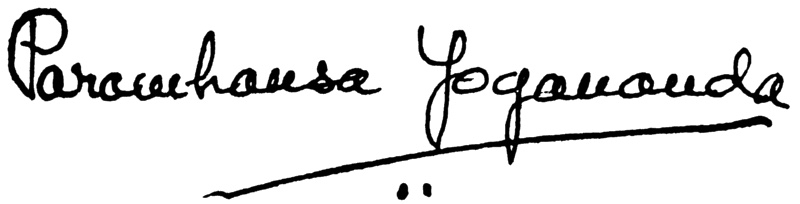
Reported events
A body unchanged for twenty days
Harry T. Rowe, Mortuary Director at Forest Lawn, wrote in a notarized letter that staff expected decay through the glass lid of the casket, that none appeared, and that the body on 27 March looked as on 7 March. SRF's publications call this a phenomenal state of immutability.
No odor of decay emanated from his body at any time.
Reported by Harry T. Rowe, mortuary director, in a letter sent to SRF, dated 15 May 1952 in Ananda's account. Recorded May 1952; quoted by Time, 4 August 1952.
The letter is real, but the body was embalmed. According to David Lane, citing Harry Edwards (1995), the fuller text of Rowe's statement says embalming took place on the night of 8 March with a customary quantity of fluid, and the death certificate carries embalmer Kenneth I. Johnson's signature. Edwards says Rowe's surprise concerned the absence of cosmetic creams. Two embalmers told him twenty days was not unusual, especially under a glass lid. The Skeptic's Dictionary reports that Rowe also noted a brown spot on the nose. We did not read the full letter, so these points rest on Lane, Carroll and SRF excerpts.
A notarized letter by the mortuary director supports the observation, so this sits at the top of the unusual band. The body was embalmed under glass, which is the plain reading of the same facts. Known here only through a summary, so lowered by about 10. Reviewer's judgment, not a calculation.
Sources: Religion: Guru's Exit; Those Who Knew Yogananda: Encinitas' Swami; The Skeptical Yogi, Part Ten: Conclusion; Incorruptible bodies; Forest Lawn Memorial-Park
Conscious departure at the Biltmore
Disciples say he entered mahasamadhi, a yogi's conscious exit from the body, on finishing a speech, and that he had hinted at the event beforehand. Time reports he joked 'Wish me luck' the day before.
Reported by SRF monastics, in Self-Realization magazine; Time. Recorded May to June 1952; Time, 4 August 1952.
The death before an audience is firmly documented. The medical verdict was acute coronary occlusion. Consciousness or intent cannot be shown. Neither explanation excludes the other for believers, but the medical finding stands.
His death at the end of a speech is firmly documented, and the medical cause was coronary occlusion. Scored is the death and the reported hints; a conscious exit cannot be shown. Reviewer's judgment, not a calculation.
Sources: Religion: Guru's Exit; Master's Mahasamadhi
Healed of cholera by a photograph
As a child with Asiatic cholera he says he gazed at Lahiri Mahasaya's photograph at his mother's urging, saw a blinding light, and recovered.
I gazed at his photograph and saw there a blinding light, enveloping my body and the entire room.
Reported by Yogananda, of his own childhood. Recorded Published 1946, about forty-five years later.
Childhood memory published decades later in a devotional work, with no medical witness. Recovery from cholera was common enough, and the diagnosis is unconfirmed.
His own childhood memory, published about 45 years later, with no medical witness and no confirmed diagnosis. Recovery from cholera was common enough. Reviewer's judgment, not a calculation.
Sources: Autobiography of a Yogi
Kashi reborn and found
Yogananda says a Ranchi pupil named Kashi died of cholera in Calcutta, that he promised to find him again, and that he located the soul in a baby by a yogic technique.
Reported by Yogananda. Recorded Published 1946.
A sole first-person report. The boy's family, the school records and the later child were not traced. The tale cannot be tested in its present form.
A sole first-person report, and the family, school and child were never traced. Finding a reborn soul is contrary as described and nothing corroborates it. Reviewer's judgment, not a calculation.
Sources: Autobiography of a Yogi
Disputes
- British India Office files survive as IOR/L/PJ/12/358, 'Swami Yogananda alias Mukanda Lal Ghose: activities in USA' (April 1925 to March 1928), and IOR/L/PJ/6/1959 File 1265, 'Activities of Swami Yogananda, a love doctor in the USA and his desire to visit India' (April 1926 to March 1928). Their contents have not been read. Secondary sources speak of surveillance and a confidential file to 1937.
- In 1928 Miami police ordered him not to speak, reportedly for fear of violence after husbands objected to their wives' lessons, and the Los Angeles Times reported a district attorney's inquiry into 'love-cult' charges at Mount Washington. The Reader says the DA found nothing criminal.
- Sri Nerode, according to his son Anil Nerode, left in 1939 after accusing Yogananda of running a harem, and sued. Dhirananda is reported to have made a similar accusation. These are allegations, and nothing was proved in court in any source opened.
- Ben Erskine claimed in 2001 to be Yogananda's son and sought exhumation. SRF's lawyer said DNA from relatives excluded this but supplied no documents when asked, according to New Times L.A. The outcome is not established here.
- SRF litigated for years against Ananda, founded by his disciple Kriyananda. The Ninth Circuit ruled on trademarks in 1995 (59 F.3d 902) and on copyright in 2000 (206 F.3d 1322), the second known here only from summaries. Those summaries state his works were not works for hire.
Still unknown
- What the two India Office files contain, and why he is called a 'love doctor'. British Library, London, in person.
- The full text of Rowe's letter as first issued in 1952.
- US immigration and FBI files; secondary sources assert surveillance, but no primary FBI document was found.
- Los Angeles Superior Court files in the Dhirananda and Nerode suits.
- Whether the 1928 New Zealand and other press items describe the Miami events accurately. A Papers Past item, seen only as a search snippet, could not be opened.
Records
Sources
primary
contemporary
hagiography
scholarly
reference