Beatified 2 May 1999; canonized 16 June 2002 by John Paul II. The Holy Office declared in 1923 that the supernatural character of the facts was not established.
Doctors, a papal visitor and the man himself left records in his lifetime, and the Holy Office published its verdicts. Most reports reach us through edited publication.
Medical reports of Dr Romanelli, May 1919 (written 49 years before their death)
Paper trail
Where they came from
Pietrelcina, Benevento, Italy (documented)
San Giovanni Rotondo, Foggia
San Giovanni Rotondo, in the shrine church; a major pilgrimage site, which a publisher's note calls the most visited Catholic shrine. Body exhumed and displayed from 2008.
Son of Grazio Forgione and Maria Giuseppa Di Nunzio, farmers. A sister became a nun.
Capuchin training from 1903. Followers point to childhood visions and the 1918 stigmata; the childhood stories come from later testimony.
Persistent illness, the First World War, poverty in the Gargano, and later long church restrictions.
Local devotion from 1918 to 1919, spread by Italian newspapers and pilgrims. Official Rome resisted for decades. John Paul II's canonization ended the dispute.
Life
Francesco Forgione came from a farming family in Pietrelcina, near Benevento. He entered the Capuchin novitiate at Morcone on 6 January 1903, took the name Pio, and was ordained at Benevento on 10 August 1910. Ill health kept him at home for long periods until 1916, when he went to San Giovanni Rotondo.
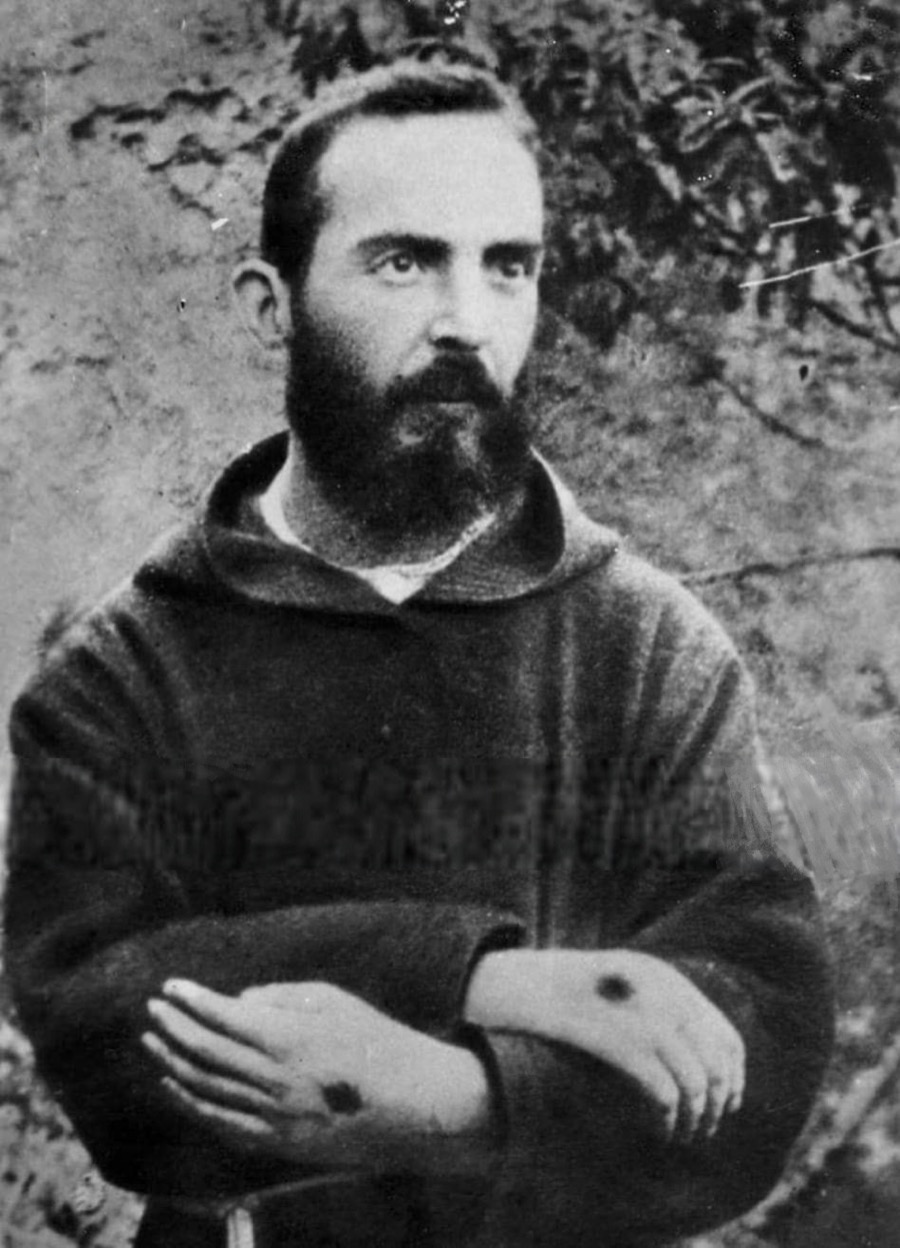
He said wounds appeared on 20 September 1918 after a vision in the choir. Doctors examined them from 1919. Crowds came, and with them conflict: local clergy, Archbishop Gagliardi of Manfredonia and the psychologist-friar Agostino Gemelli accused or doubted him, and the Holy Office sent Bishop Raffaello Rossi of Volterra as visitor in June 1921.
The Holy Office issued public warnings in 1923, 1924, 1926 and 1931. He was barred from public ministry from 1931 until restrictions were lifted in 1933 and 1934. After the war his hospital, the Casa Sollievo della Sofferenza, opened on 5 May 1956 with large gifts from donors. A second visitation under Carlo Maccari in 1960 was critical; restrictions returned, and they were eased under Paul VI.
He died on 23 September 1968. Sources report that the wounds had disappeared by then. His cult is one of the largest in modern Catholicism.
non constare de eorumdem factorum supernaturalitate
Images
Reported events
The stigmata
Open wounds on hands, feet and side, first reported in September 1918, were said to last about fifty years without healing or infection.
non constare de eorumdem factorum supernaturalitate
Reported by Padre Pio under oath; physicians Romanelli, Bignami and Festa; Bishop Rossi; hostile observers. Recorded From 1919, in medical reports and Holy Office files.
Wounds certainly existed and were examined. The cause is what is disputed. Romanelli and Festa thought them beyond natural explanation. Bignami, a Rome pathologist, proposed a morbid or suggestive origin kept open by chemicals such as iodine, which Padre Pio did use, though accounts differ on his exact words. Sealed dressings for eight days left the wounds unchanged, according to a compilation of the reports. Gemelli said he did no physical examination, yet called them self-produced. The 1923 Holy Office finding was that the supernatural was not established, which Castelli reads as a suspended judgment. No modern pathology was done. Wounds were reported gone at death.
Doctors and a visitor examined the wounds within a few years, some of them hostile, so wounds certainly existed. Their cause is not scored; the fifty years without healing or infection rest on less, and no pathology was done. Known here only through a summary, so lowered by about 10. Reviewer's judgment, not a calculation.
Sources: Padre Pio: medical and ecclesiastical examinations; Padre Pio; The Secret Story of Padre Pio's Stigmata; Padre Pio, storia da rifare?; The bloody truth
The carbolic acid allegation
Pharmacist Maria De Vito testified that in 1919 he asked her privately for pure carbolic acid and later four grams of veratrine, and her cousin, pharmacist Valentini Vista, reported this to Bishop Bella of Foggia.
Reported by De Vito and Vista, in documents sent to the Holy Office and published by Sergio Luzzatto. Recorded 1919 to 1920.
The documents are real and Rossi questioned Padre Pio about them; he said the acid was to sterilise syringes for novices' injections. Luzzatto reports the testimony without stating a conclusion, and points out the dose far exceeded medical use. Gaeta and Tornielli argue it reached Rome through Archbishop Gagliardi, an opponent. Castelli argues carbolic acid would have caused inflammation that was not seen. A purchase is not proof of use on the wounds. This remains an allegation.
Event scored: that the pharmacist testified to his request for the acid, which he himself acknowledged with another explanation. A purchase is not proof of use on the wounds. Known here only through a summary, so lowered by about 10. Reviewer's judgment, not a calculation.
Sources: The Secret Story of Padre Pio's Stigmata; Padre Pio, acido fenico e stimmate (archive article); Padre Pio: Miracles and Politics in a Secular Age; Padre Pio Under Investigation: The Secret Vatican Files
Sworn account of the wounds
On 15 June 1921, under oath to Rossi, he said he had no wounds before the 1918 vision, did not ask for them, and had none on his back.
Reported by Padre Pio, in Rossi's file, published by Castelli. Recorded June 1921, published 2008.
This is his own sworn statement, known here through a press account of Castelli's edition. We did not read the edition itself.
Event scored: that he swore to this before Rossi in 1921. Whether the account is complete is another matter, and only a press report of the edition was read. Known here only through a summary, so lowered by about 10. Reviewer's judgment, not a calculation.
Scent of violets
Bishop Rossi's file records a smell of violets from the wounds, not the odour of necrosis.
Reported by Witnesses in Rossi's report, per ZENIT's account. Recorded 1921.
Mentioned in a press summary of Rossi's report. Whether Rossi himself smelled it is not clear.
Recorded in a formal file within three years, but it is unclear who smelled it. Medicines on the dressings are an untested candidate. Known here only through a summary, so lowered by about 10. Reviewer's judgment, not a calculation.
Bilocation to the Vatican
A story says he appeared at the Vatican in 1933 before Pius XI while also praying at San Giovanni Rotondo.
Reported by Il Messaggero, 8 November 1999, as summarised by Michael Potts. Recorded 66 years after the event.
The story names 'Cardinal Siri' as a witness in 1933. Giuseppe Siri became a cardinal only in 1953, so the detail as printed is suspect. Other bilocation stories rest on devotees. Potts reports that Padre Pio said such events happened during prayer.
First printed 66 years later in a newspaper, with an anachronistic witness, since Siri was not a cardinal in 1933. Scored at the bottom of the band. Known here only through a summary, so lowered by about 10. Reviewer's judgment, not a calculation.
Sources: Padre Pio
Disputes
- The Holy Office told the faithful to avoid visiting him or writing to him, in a notice of 23 April 1926 citing its declarations of 1923 and 1924.
- Agostino Gemelli wrote that the wounds were fruits of suggestion and later called him a psychopath, though Gemelli admitted he had not physically examined the friar.
- Archbishop Pasquale Gagliardi made accusations about the wounds in the 1920s. The Maccari visitation of 1960 was critical, and listening devices were reportedly placed in his cell and confessional in that period.
- Luzzatto has examined his links with the Fascist-era politics of the region, including Giuseppe Caradonna. Defenders dispute how far this reached.
- The medical compilation I used disagrees with other sources on who sent Bignami: the Capuchin general or the Holy Office.
Still unknown
- The full text of the physicians' reports. Gerardo da Flumeri's Le stigmate di Padre Pio (1995) prints them, per the compilation I used; We found no free copy.
- The contents of the Maccari report of 1960, including allegations about his dealings with women, which we did not verify. Holy Office files were opened only to 1939 when Castelli wrote; later files may now be open.
- The original Vista and De Vito papers, in the Archive of the Dicastery for the Doctrine of the Faith, Rome.
Records
Sources
primary
scholarly
reference