Not recognised by the Catholic Church. Revered as a folk saint by the fidencistas, who still go to Espinazo.
Daily national press, doctors' eyewitness reports, a civil register and his own letter to Calles all date from his lifetime. No medical follow-up of any cure is known.
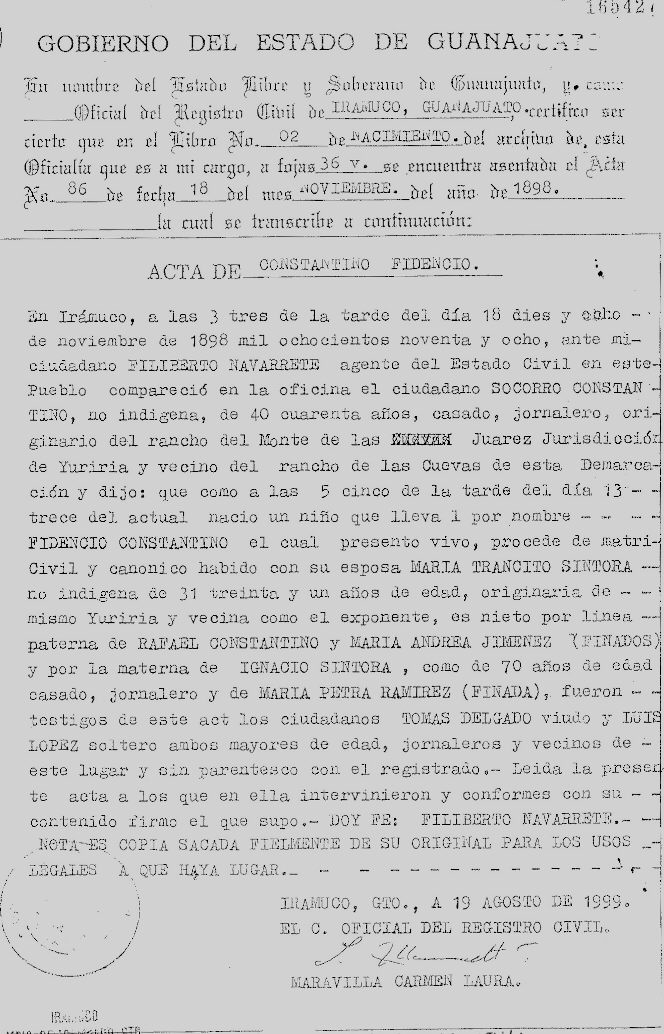
Civil birth record of 1898; for his healing, an official notice of August 1927 (written 40 years before their death)
Paper trail
Where they came from
Rancho de las Cuevas, Iramuco, Guanajuato, Mexico (Yuriria in Agostoni) (documented)
Hacienda de Espinazo, Mina, Nuevo León
Espinazo, Nuevo León; still a pilgrimage place with large gatherings.
Father a labourer aged 40, mother aged 31, both from Yuriria. Not recorded as indigenous. Orphaned young per Agostoni. No religious lineage.
Three years of primary school. Worked as a cook and a midwife per Agostoni. Local stories of Father Segura. Followers hold he cured by divine mandate.
Orphanhood, the Mexican Revolution, the Cristero War, and a region without doctors.
Hacienda workers from 1925. Von Wernich's photograph, then newspapers from 1927, then the president.
Life
Fidencio Constantino was born to a labouring family in Guanajuato. The civil register at Iramuco records his birth on 13 November 1898 at the rancho de las Cuevas area, to Socorro Constantino, labourer, and María Trancito Síntora. Agostoni says he lost his parents by the age of six or seven, had three years of school, and was protected throughout his life by Enrique López de la Fuente. Stories of his youth are many and contradictory.
He reached the Espinazo hacienda of the German spiritist Teodoro von Wernich in 1921 or 1923. From 1925 he cared for injured workers and women in labour. In 1927 von Wernich, cured of an illness doctors could not treat, spread his photograph. By December 1927 the press counted over 4,000 people at Espinazo, and later estimates reached 30,000.
President Calles came on 8 February 1928, for about three hours. The press flooded in, and the camp became the Campo del Dolor. Doctors protested at the filth and deaths, but the federal health department found it could not prosecute a man who did not call himself a doctor. A case in Nuevo León in 1929 failed. He treated the sick until his health declined in 1937 and died at Espinazo on 19 October 1938.
hombres y mujeres y niños de todas las clases; se escuchan diversidad de idiomas, se observan las costumbres más encontradas.
Images
We found no free photograph of Fidencio. A Commons photo of a Fidencista medium was dropped because it may show a living private person.
Reported events
The cure of the hacienda owner
In 1927 Fidencio cured Teodoro von Wernich of an illness that licensed doctors could not diagnose or cure. In gratitude von Wernich promised to make him famous and distributed his photograph.
Reported by Tradition reported by historians, ultimately from local sources.. Recorded Date of earliest account not established; cited by Agostoni 2018..
The illness is unnamed in our sources, and no medical record is known. Von Wernich's photograph and promotion is the more important fact, because it explains the fame. A spiritist patron had his own reasons to believe.
The patron's promotion of him is the solid fact. The illness is unnamed, and no medical record or date of first account was found. Known here only through a summary, so lowered by about 10. Reviewer's judgment, not a calculation.
Sources: Ofertas médicas, curanderos y la opinión pública: el Niño Fidencio en el México posrevolucionario
The president's visit
On 8 February 1928 Calles arrived by the presidential train Olivo, spoke with Fidencio and was alone with him at the Espinazo school. The press said he came out wearing one of Fidencio's robes and that he and his party took a brew. Tradition says he was cured of a skin disease, sometimes called leprosy.
Reported by Mexican press; Barbara Macklin, citing reports; oral tradition.. Recorded Press from 9 February 1928..
The visit is secure. Its purpose is not: it came during a northern tour and the Cristero War, and Agostoni reads it as either anticlerical gesture or a response to Calles's poor health and interest in spiritism. No photographs were allowed. Claims of a cure are tradition. We found no medical document. The robe and the brew go back to press reports I read only in Agostoni's paraphrase of Macklin.
The visit of 8 February 1928 is secure from the press. Scored is the cure, which is tradition only, with no medical document. Known here only through a summary, so lowered by about 10. Reviewer's judgment, not a calculation.
Sources: Ofertas médicas, curanderos y la opinión pública: el Niño Fidencio en el México posrevolucionario
Surgery with bottle glass
Fidencio operated with glass disinfected in alcohol and treated people by swinging them, bathing them and singing. A doctor who visited incognito in 1930 described these methods first hand.
Fidencio ha sido un exponente ridículo de nuestra ignorancia ante el mundo civilizado
Reported by Dr Francisco Vela González, federal health delegate in Nuevo León, a hostile medical eyewitness; a photograph in the Calles archive.. Recorded Vela visited 27 May 1930; his report leaked to El Porvenir..
This is the best medical witness. Vela saw the methods and called them a farce. He does not record cures, and we read him only through Agostoni citing Garza Quiroz. Wikipedia notes operations without anaesthesia. We found no case study. FAPECFT holds a photograph that Agostoni reproduces under the heading of a bottle-glass operation.
A hostile federal health officer saw the methods himself, and a photograph survives. He records the surgery, not any cure. Known here only through a summary, so lowered by about 10. Reviewer's judgment, not a calculation.
Sources: Ofertas médicas, curanderos y la opinión pública: el Niño Fidencio en el México posrevolucionario
Mass cures at the Campo del Dolor
Thousands claimed cures in 1928. Excélsior printed testimony from a visiting priest, Father Méndez, who believed in the treatment and said Fidencio refused money, while doctors and deputies reported people dying daily for lack of care.
Lo he visto rechazar una gruesa suma de dinero que le ofrecía uno de sus agradecidos pacientes.
diariamente se están muriendo numerosas personas por falta de atención médica
Reported by Newspapers of 1927 and 1928, including a priest quoted in Excélsior and doctors such as Felipe Brachett.. Recorded 1927-1928..
The crowds are as well attested as anything in this archive. The cures are testimonies without follow-up. Federal health chief Bernardo Gastélum said he would investigate Fidencio's abilities; We did not find the results. Reporter Manuel Becerra Acosta thought the treatments natural, not supernatural.
The crowds are as well attested as anything in the archive. Scored is the cures, which are testimonies without follow-up, set against reports of daily deaths. Known here only through a summary, so lowered by about 10. Reviewer's judgment, not a calculation.
Sources: Ofertas médicas, curanderos y la opinión pública: el Niño Fidencio en el México posrevolucionario
Healing after death through mediums
Followers hold that Fidencio continues to heal, working through mediums called cajitas or materias, and they make pilgrimage to his tomb at Espinazo.
Reported by Fidencistas.. Recorded Ongoing since 1938..
Agostoni confirms ongoing pilgrimage and medico-religious practice. Rodríguez Castillo says the healing work of the cajitas keeps the devotion going. Details should be checked in Macklin and in Berlanga, Lara and Ramírez, Las fiestas del dolor.
Event scored: the continuing practice of mediums and pilgrimage, which scholars have observed. No individual cure is scored. Reviewer's judgment, not a calculation.
Sources: Ofertas médicas, curanderos y la opinión pública: el Niño Fidencio en el México posrevolucionario; El niño Fidencio: de curandero a santo
Disputes
- Doctors called him a charlatan and a danger to public health. Francisco González Castro attacked him in El problema social y legal del charlatanismo (1947).
- Agostoni argues he was not a charlatan in the strict sense: he claimed no degree, did not sell miracles and did not wander.
- Nuevo León brought a formal case in 1929 for illegal practice. His lawyer José F. Guajardo argued that he used only herbs, and the case failed.
- As early as August 1927, Rodríguez Castillo reports, the civil judge of Espinazo, Tomás Olivares, warned the state government of a healer deceiving the people.
- Reports that a look-alike's death was announced a year before his own, and stories of his manner of death, are unverified; Wikipedia relies on a local newspaper for the first.
- The Catholic Church has not recognised him. A Fidencista church was founded about 55 years after his death, according to Rodríguez Castillo.
Still unknown
- Why Wikipedia gives 17 October 1898 when the civil record says 13 November. The record is a certified 1999 copy, posted to Commons by Cadena's site; the original book at Iramuco should be seen.
- His death certificate and any autopsy.
- Whether Gastélum's brigade reported, in the health archive (Archivo Histórico de la Secretaría de Salud, not confirmed).
- Whether Calles answered the letter of 25 January 1929.
- The 1929 Nuevo León case file.
Records

Sources
primary
contemporary
scholarly
reference