Regarded by many devotees as a manifestation of Hanuman. Temples at Kainchi, Vrindavan and Taos, New Mexico continue his following.
Eyewitness devotee memoirs and interviews exist, but almost all were written after 1973, and Langmuur stresses how little else survives. The McKenna checks show what records can add.
Ram Dass, Be Here Now (1971) (written 2 years before their death)
Paper trail
Where they came from
Akbarpur, Firozabad district, Uttar Pradesh, India (United Provinces); about 35 km from Agra (traditional)
Neeb Karori area; then Nainital district and Vrindavan from about 1940
Cremated at the Vrindavan temple; samadhi shrines at Vrindavan and Kainchi, both visited
Father Shri Durga Prasad Sharma, described as a prosperous Brahmin landowner. Accounts mention a stepmother. Wife, two sons including Dharma Narayan, and a daughter.
No authorised lineage. A Vaishnava holy man in Gujarat is said to have named him Lakshman Das. All details come from hagiography.
Hagiography reports punishment by a stepmother and flight in boyhood. Langmuur notes that versions differ.
Local reputation at Neeb Karori, including the train story, then devotees around Nainital from the 1940s. Ram Dass spread it worldwide after 1967.
Life
All commentators agree he was born Lakshmi Narayan Sharma at Akbarpur, a small village about thirty-five kilometres from Agra, son of Durga Prasad Sharma. His year of birth is not known, and 1900 is a Western estimate. Akbarpur is too small to appear in the district gazetteer of his youth. Stories of leaving home at eleven differ, but he had a wife, two sons and a daughter, and most devotees did not know this until his death.
He wandered under many names. Scholars can follow him only through hagiography, including a stay in caves near the village of Neeb Karori, which gave him his best known name. From about 1940 he spent more time around Nainital, and temples at Kainchi and Vrindavan were built for him.
Richard Alpert, later Ram Dass, met him in 1967, and Be Here Now made him famous. A Western satsang formed, including Larry Brilliant. He died at about 1.15 a.m. on 11 September 1973 at the Ramakrishna Mission Hospital, Vrindavan, after being diagnosed in a diabetic coma, and his body was cremated at his temple.
Images
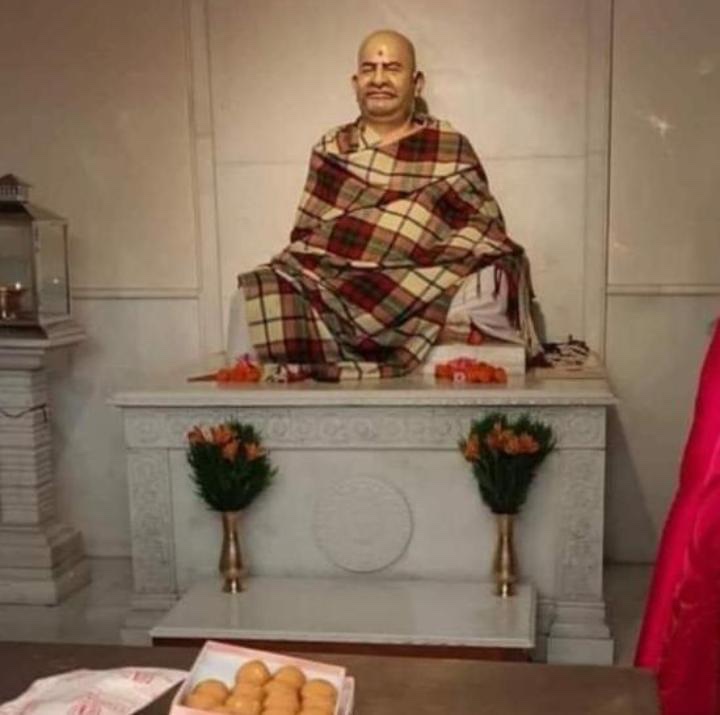
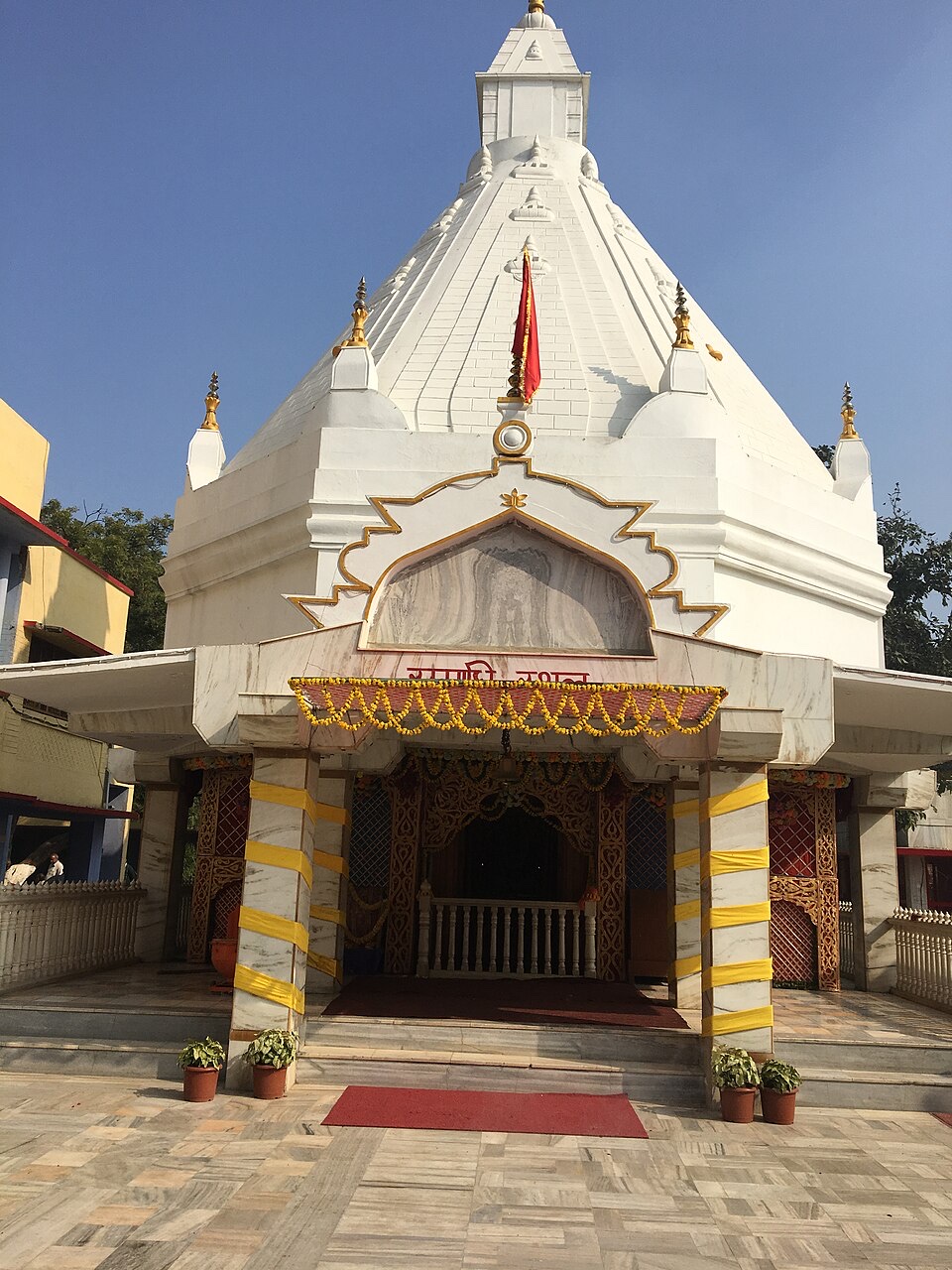
No photograph from life with a confirmed licence was found. Commons portraits carry 'public domain' or 'CC0' tags from uploaders with no evidence they hold rights in photos of a man who died in 1973, so they were not used. Images here are of his shrines.
Reported events
The train that would not move
Ejected from a first class carriage near Neeb Karori, he sat on the platform and the train would not start for two hours until railway staff invited him back. A version adds that he produced first class tickets.
Reported by Hagiography, including Pande's The Divine Reality. Recorded Written after 1973.
Langmuur classes it as hagiography. Nobody is named and no railway record is cited. It explains his name, a common feature of such tales. It should be easy to check against railway records if a date existed.
No witness is named, no date is given and no railway record is cited, and the story explains his name, as such tales often do. A delayed train is ordinary, so the score reflects the empty record. Reviewer's judgment, not a calculation.
Sources: Becoming the Breath of Ram: The Life and Teachings of Neem Karoli Baba
No effect from LSD
Ram Dass says that in 1967 he gave the guru three LSD pills of 305 micrograms each, 915 in all, and that nothing happened. Some accounts add a repeat test.
nothing happened
Reported by Ram Dass, devotee, first-hand. Recorded Be Here Now, 1971.
Terence McKenna suggested sleight of hand. Paul Krassner wrote in 2001 that Ram Dass admitted inventing it, then retracted. Stanley Krippner saw no reason to doubt it, and Ram Dass stood by it. John Horgan, who reported all this, doubts it. The dose in the pills was never independently measured.
A named participant published within about four years, though the claim was later disputed and then reaffirmed. The dose was never measured, and sleight of hand is a live candidate. Known here only through a summary, so lowered by about 10. Reviewer's judgment, not a calculation.
Sources: Baba Ram Dass and the Tale of the Acid-Gobbling Guru
Prediction to Colonel McKenna
Hagiography says a strict British colonel who despised sadhus was won over and told he would become a general. Langmuur tested the story against the Indian Army List and Who Was Who.
Reported by Pande, Josi, Singh and Mukerjee, devotees; Katya Langmuur, scholar. Recorded After 1973.
James Charles McKenna existed and commanded in India, retiring on 1 April 1936 as a brigadier, and died in 1943. He did not become a general. The Army Personnel Centre told Langmuur in 2008 that it holds no file for him, which undercuts the claim of later British Army service. A meeting is plausible; the prophecy fails on the record.
A meeting is plausible. Scored is the prophecy, and army records show that McKenna retired a brigadier and never became a general. Reviewer's judgment, not a calculation.
Sources: Becoming the Breath of Ram: The Life and Teachings of Neem Karoli Baba
Disputes
- He had a wife and children, which came as a surprise to many Western followers at his death, as Larry Brilliant recalled. Langmuur says insiders do not explain why he kept his family apart.
- Ram Dass's own warning that there can be no biography is itself a reason to be cautious. Nearly all sources are devotional and were written after 1973.
- Many devotees treat him as an incarnation of Hanuman. Langmuur treats Hanuman as a model for how he mediated between divine and human, and the identification is a matter of belief.
Still unknown
- Year of birth; Langmuur found no civil record, and the village is absent from the gazetteer.
- The Ramakrishna Mission Hospital, Vrindavan, admission record of 10 and 11 September 1973.
- Any Indian press report of his death. Langmuur says All India Radio broadcast the news.
- His Ram-writing diaries, shown in Langmuur's appendix. Their present keeper needs confirming.
Records
Sources
contemporary
hagiography
scholarly