Revered as a prophet by The Church of Jesus Christ of Latter-day Saints, Community of Christ and other Latter Day Saint churches. His critics, from his own day onward, called him an impostor.
His own writings, court papers, dated revelations, a diary record and hostile accounts all survive from his lifetime. For the claimed miracles, the record is good on what witnesses said and weak on independent or medical verification.
Fee bills of the 1826 Bainbridge hearing (written 18 years before their death)
Paper trail
Where they came from
Sharon, Vermont, USA (documented)
Palmyra and Fayette, New York; Harmony, Pennsylvania; Kirtland, Ohio; Missouri; Nauvoo, Illinois
Smith Family Cemetery, Nauvoo, Illinois, by general report; not verified from a primary source here
Fifth of eleven children of Joseph Smith Sr., a cooper, farmer, teacher and merchant, and Lucy Mack Smith. Poor, indebted farmers on rented land, and not a clerical family. The family mixed Christian worship with treasure seeking.
A few years of schooling. No ministerial training. Seer stone practice in the 1820s. Followers point to the First Vision and to the angel Moroni in 1823. The Church's essay ties his later translation to his earlier use of the stone.
His father's financial ruin and repeated moves, foreclosure at Manchester, the religious excitement of western New York, and later repeated expulsions, imprisonment and mob attack.
First by his own family, the Whitmers and Knights, and neighbours such as Martin Harris. It spread through the 1830 Book of Mormon, the witnesses' statements and missionaries. Sidney Rigdon's Ohio congregation brought a mass of converts, a detail from general histories that was not rechecked here.
Life
Joseph Smith was born in Sharon, Vermont, in 1805, the fifth of eleven children of Joseph Smith Sr. and Lucy Mack Smith. Debt and a failed business cost his father his farm; the family moved often, reached Palmyra, New York, about 1816, and lost a later farm at Manchester to foreclosure. He had only a few years of schooling. Like others of his day, the family looked for lost things with rods and seer stones. In 1826 he appeared before a justice at Bainbridge, and in January 1827 he married Emma Hale.
He said that God had called him in a vision and that the angel Moroni led him to gold plates. He dictated the Book of Mormon mostly in about three months in 1829, often looking at a seer stone in a hat according to the Church's essay, and published it in 1830 with the signed statements of eleven witnesses. He organized his church that April. The Church moved to Kirtland, Ohio, and to Missouri, where members were expelled in 1833 and again later. He spent over four months in Liberty Jail from December 1838, charged with treason.
From 1839 he built Nauvoo, Illinois, on the Mississippi, serving as mayor and militia leader. He privately taught and practised plural marriage. Former leaders, including William Law, published the Nauvoo Expositor on 7 June 1844 attacking this and his power. Smith as mayor, with the city council, ordered the press destroyed on 10 June. Facing riot charges, he surrendered at Carthage. On 27 June 1844 a mob stormed the jail and killed him and his brother Hyrum. Five men tried for the killings were acquitted in 1845.
Few religious founders are so well documented. Thousands of his papers survive and are now published by a Church-owned project that prints evidence awkward to the Church, while hostile neighbours, dissenters and officials also left records.
he was full of levity, even to boyism romping; dressed like a dandy, and at times drank like a sailor and swore like a pirate.
You are hereby commanded to destroy the printing establishment press from whence issues the Nauvoo Expositor
Joseph was in Montrose & it was a day of Gods power
Images
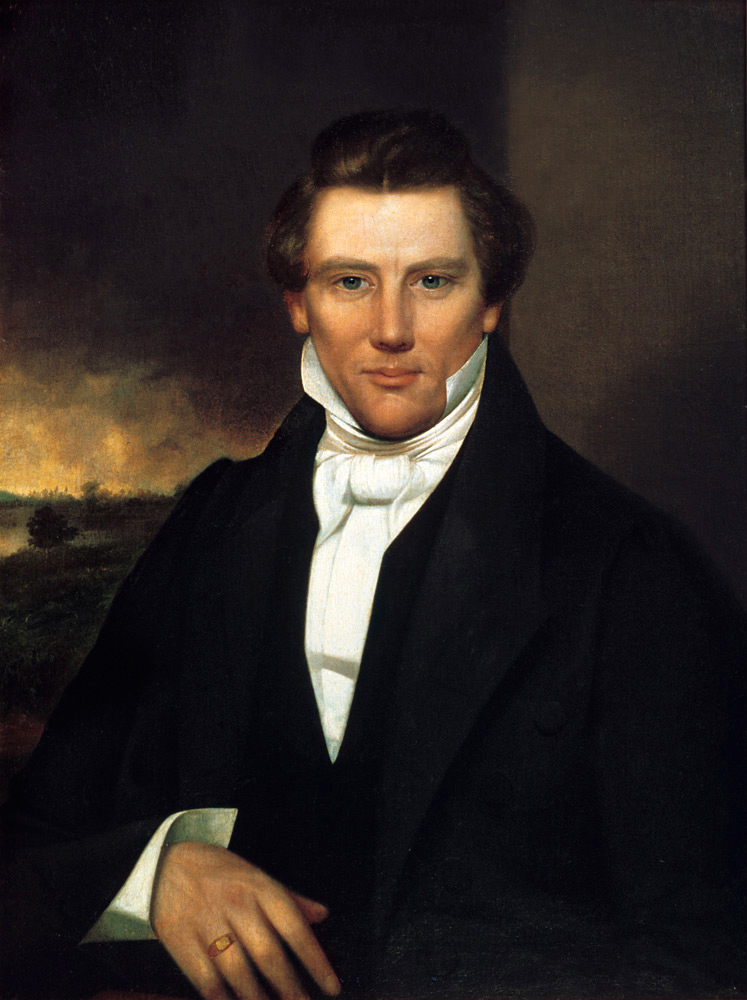
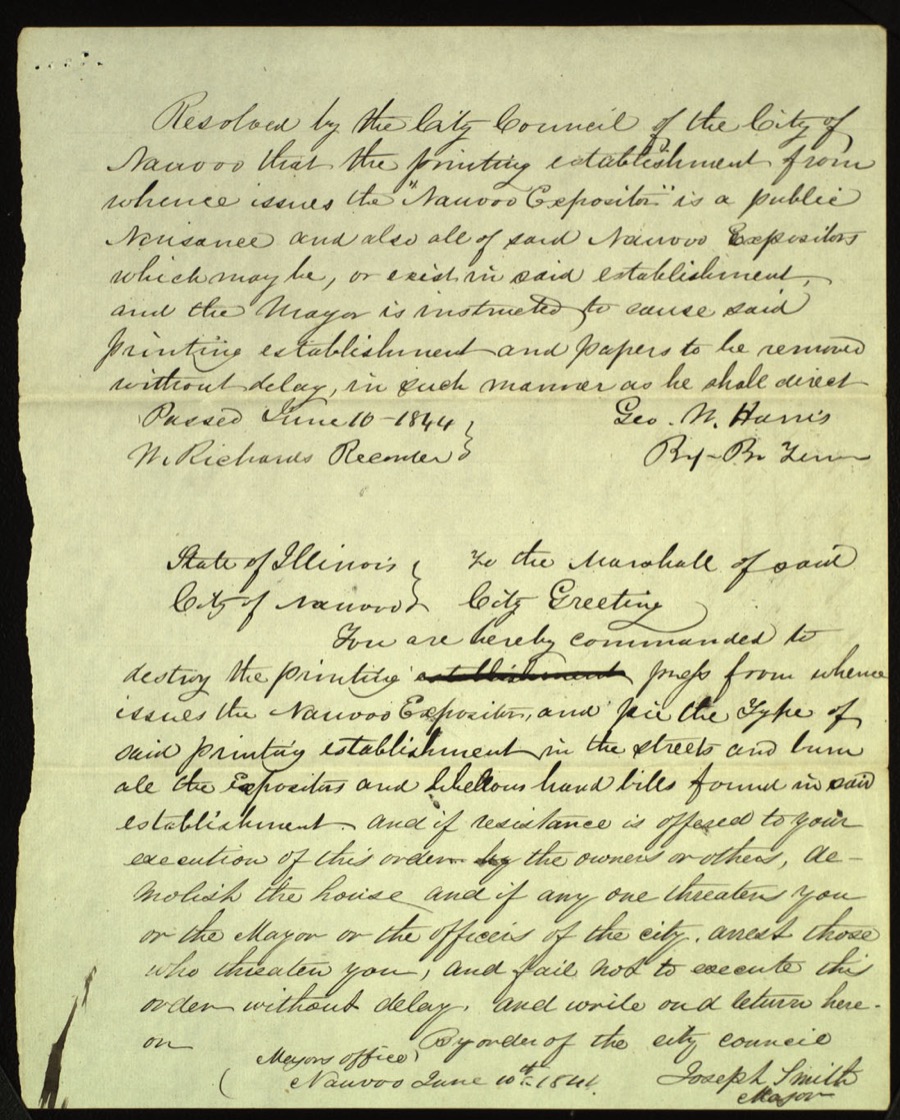
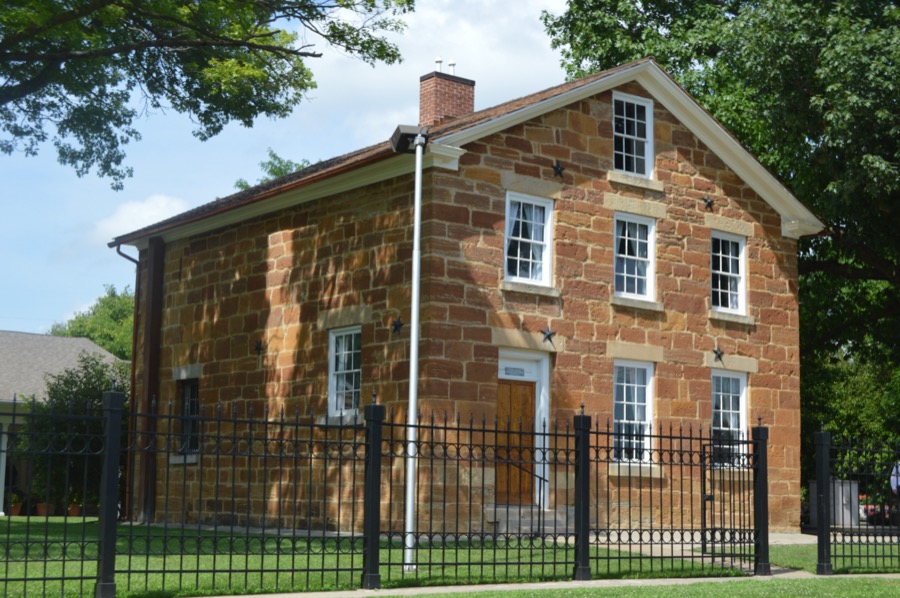
The photograph sometimes claimed as a Joseph Smith daguerreotype was not used, because that identification is disputed. The print copy of the portrait is only 747 pixels wide; a higher resolution scan would have to be requested from Community of Christ.
Reported events
The First Vision
Smith said that about 1820, as a teenager praying over his sins and which church was true, he saw a light and a heavenly being or beings. In 1832 he wrote that he saw the Lord; later accounts describe two personages, whom Latter-day Saints identify as the Father and the Son.
a piller of fire light above the brightness of the sun at noon day come down from above and rested upon me
Reported by Joseph Smith himself. Recorded 1832, about twelve years after the event.
The earliest account is in his own hand, but no witness shared the vision, and no 1820 record of it was found here. The Church's essay says the accounts tell a consistent story that differs in emphasis. Critics stress the differences: the 1832 text speaks of the Lord and centres on forgiveness, while later texts name two personages and centre on the churches. Two of the accounts were unpublished until rediscovered in the 1960s.
Event scored: the vision as an experience. The earliest account survives in his own hand but dates twelve years after the event, and later accounts differ in emphasis. Reviewer's judgment, not a calculation.
Seeing hidden things in a stone, 1826 hearing
Before a justice at Bainbridge, New York, Smith was charged in 1826 as a disorderly person for seeking treasure with a seer stone. Witnesses disagreed: farmer Josiah Stowell swore he truly could see hidden things, others left disgusted, and the treasure was never recovered.
The deception appeared so palpable that witness went off disgusted.
he positively knew that the prisoner could tell, and did possess the art of seeing those valuable treasures through the medium of said stone
Reported by Printed docket of Justice Albert Neely, from pages now lost; fee bills of 1826; William Purple, 1877. Recorded 1826 fee bills; docket printed 1873, 1883, 1886.
The Joseph Smith Papers accepts that the hearing took place and that the printed docket was probably based on an authentic source, since fee details match the surviving bills, but warns that the original is lost and each printing differs. The verdict is uncertain: the docket as printed says guilty, Purple says he was discharged, Cowdery said acquitted, and Benton and Noble said condemned. The Papers finds points against a conviction, such as no bridewell record. Testimony is the best sworn evidence in Smith's life about seer practice, but it shows belief, not any proven find. Stowell said the stone worked; he and Thompson were followers of the practice. In the docket, the chest always moved away, and the money was gone.
Sworn testimony exists, but in printings from lost pages that match the 1826 fee bills. Witnesses disagreed, and no treasure was ever produced, so scored like other unproved claims of hidden knowledge. Reviewer's judgment, not a calculation.
Sources: Introduction to State of New York v. JS-A; Appendix: Docket Entry, 20 March 1826; The Original Prophet. By a Visitor to Salt Lake City; Fee Bill, circa 9 November 1826; Appendix: Reminiscence of William D. Purple, 28 April 1877; Book of Mormon Translation
The Three Witnesses and the angel
Oliver Cowdery, David Whitmer and Martin Harris signed a statement that in June 1829 an angel laid the gold plates before their eyes and that God's voice declared the translation true.
an Angel of God came down from heaven, and he brought and laid before our eyes, that we beheld and saw the plates, and the engravings thereon
he never saw them only as he saw a city through a mountain
Reported by Cowdery, Whitmer and Harris, close associates of Smith. Recorded Late June 1829; printed 1830.
Three named men signed within days and the statement was printed within a year. All three later fell out with Smith, and believers stress that none retracted, a point from general histories not rechecked document by document here. In Burnett's own 1838 letter Harris still insists the book is true. Critics point to the language of vision: Burnett reported that Harris said he saw the plates only as one sees a city through a mountain. Rappleye and Smoot, Latter-day Saint authors, argue that Burnett was a polemical and at best third-hand reporter. The Papers says the text was likely drafted by Cowdery or another witness. The plates were not kept for inspection. The witnesses were associates with hopes and, in Harris's case, money at stake.
Three named men signed within days, and none is shown here to have retracted, which is strong testimony. An angel showing plates is contrary as described, and with several named witnesses but none hostile or sworn this sits in the middle of the band. Reviewer's judgment, not a calculation.
Sources: Appendix 4: Testimony of Three Witnesses, Late June 1829; Stephen Burnett to Lyman E. Johnson, 15 April 1838; A History of Illinois from Its Commencement as a State in 1818 to 1847; Stephen Burnett versus the Eight Witnesses: An Exercise in Mature Historical Thinking
The Eight Witnesses handled the plates
Eight men, all Whitmers or Smiths or related to them, signed that Smith showed them plates with the appearance of gold, and that they handled the leaves and saw engravings.
we have seen and hefted, and know of a surety, that the said Smith has got the plates of which we have spoken
The most probable account of these certificates is, that the witnesses were in the conspiracy, aiding the imposture
Reported by Christian, Jacob, Peter Jr. and John Whitmer, Hiram Page, Joseph Smith Sr., Hyrum Smith, Samuel H. Smith. Recorded Late June 1829; printed 1830.
The text describes an ordinary physical object, with no angel, so it is the strongest material claim. John Whitmer repeated in 1836 that he had handled them. Against this, all eight belonged to two allied families. Burnett's 1838 letter has Harris saying that the eight never saw the plates and hesitated to sign, though Burnett is a hostile reporter, and in the same letter Harris says he hefted the plates in a box. Rappleye and Smoot reject Burnett as a source on the Eight, while skeptics such as Dan Vogel rely on him. Ford repeated an unsourced story of an empty box. The statement could describe real metal plates of unknown origin, a fabricated object, or be a false statement.
Eight named men signed within days to handling a physical object, which is the file's strongest material claim. All belonged to two allied families and no plates can be examined. Reviewer's judgment, not a calculation.
Sources: Appendix 5: Testimony of Eight Witnesses, Late June 1829; Stephen Burnett to Lyman E. Johnson, 15 April 1838; A History of Illinois from Its Commencement as a State in 1818 to 1847; Stephen Burnett versus the Eight Witnesses: An Exercise in Mature Historical Thinking
Casting a devil out of Newel Knight
At Colesville in April 1830 Newel Knight was found with face and limbs distorted and thrown about the room. Smith took his hand, rebuked the devil in Jesus's name, and Knight said he saw the devil go. Smith's history calls it the first miracle in the church.
almost unconsciously I rebuked the devil, and commanded him in the name of Jesus Christ to depart from him
Reported by Joseph Smith; Newel Knight, as quoted in Smith's history. Recorded In the manuscript history, begun 1838; this page written by James Mulholland.
The account comes from the two men involved, recorded about eight or nine years later, with eight or nine neighbours said to be present but not named. No outside record was found. Knight's own autobiography at BYU was not read. The behaviour fits religious excitement or a seizure-like episode, and Smith himself says it followed Knight's distress over failing to pray aloud.
The two men involved, recorded about nine years later, with no neighbour named and no outside record. A violent episode ended by reassurance is credible; the devil seen leaving is Knight's experience. Reviewer's judgment, not a calculation.
Sources: History, 1838-1856, volume A-1
Elsa Johnson's lame arm
In 1831 at Kirtland, Smith took Elsa Johnson of Hiram by the hand and commanded her in Christ's name to be whole. She reportedly lifted her arm at once and could do her washing the next day. Her husband's family and the preacher Ezra Booth joined him.
The sudden mental and moral shock
Reported by A. S. Hayden, historian of a rival church, without naming his informants. Recorded 1875 or 1876, about 45 years later.
The value lies in the source. A hostile history calls it a well attested fact, and offers a natural cause instead of denying it. But it was first read here 45 years later, with no medical record and no direct statement from Elsa. Booth, who was present and later turned against Smith in 1831 letters, is not shown here as testifying to this. The nature of the original complaint is unknown: Hayden calls it rheumatic.
A rival church's historian concedes the event, which counts for something, but he writes 45 years later without naming informants. The complaint is unknown and a functional cause is likely. Reviewer's judgment, not a calculation.
Sources: Early History of the Disciples in the Western Reserve, Ohio; Mormonism Unvailed
The day of God's power, 22 July 1839
During a malaria epidemic among the refugees at Commerce and Montrose, Smith went among the sick, took them by the hand and commanded them to rise. Woodruff's journal says they leaped from their beds, including Elijah Fordham, who followed him from house to house.
they leaped from their beds made whole by the power of God
Reported by Wilford Woodruff, apostle and eyewitness. Recorded Journal entry for 22 July 1839, written at or near the time; much fuller versions from 1857 onward.
A journal entry by a participant is strong for what he believed he saw. Woodruff's retellings grow: the 1839 entry is short, while drafts from 1857 add Joseph B. Noble, the twin children and the red silk handkerchief, and later versions, including Leaves from My Journal, add the healing of Brigham Young. Accounts attributed to others, such as Heber C. Kimball and Parley P. Pratt, were not opened. Malaria relapses and remits, and the Saints went on dying: the Papers note that deaths from malaria peaked in August and September of 1839 and 1840. Fordham lived until 1879, according to Woodruff Papers' index. No medical record exists. There is no hostile or neutral eyewitness, although later versions say the wicked rabble followed.
A same-day journal by a participant is strong for what he believed he saw, and only the short 1839 entry is scored. Malaria remits, the deaths went on, and the fuller versions grow with time. Reviewer's judgment, not a calculation.
Sources: Wilford Woodruff journal entry and later accounts of 22 July 1839; Proclamation, 15 January 1841, editorial note on malaria
The war prophecy of 25 December 1832
Smith dictated a revelation that wars would soon begin at the rebellion of South Carolina, would lead to the slaves rising, and would be poured out on all nations. South Carolina's secession began the American Civil War in 1860-1861.
the wars that will shortly come to pass begining at the rebellion of South Carolina
Reported by Joseph Smith, in a dated manuscript. Recorded Copied into Revelation Book 2 by about February 1833.
Date and text are secure, which is rare for a prophecy. The Papers shows the context: the Painesville Telegraph of 21 December 1832 reported South Carolina's Nullification crisis and its threat of a separate government, along with cholera and plague. So the idea of rebellion there was in the news that week. The crisis itself was settled and war came 28 years later. Wars on all nations were broader and did not follow as described. Believers note that the place was named decades early.
The date and text are secure, which is rare. South Carolina's rebellion was in that week's news, war came 28 years later, and the wider predictions did not follow as described. Reviewer's judgment, not a calculation.
The Kinderhook plates
In 1843 men brought six small brass plates, said to be from an Illinois mound, to Nauvoo. Clerk William Clayton recorded that Smith said they contained the history of a descendant of Ham. The plates were a hoax.
the history of … a descendant of Ham through the loins of Pharaoh king of Egypt
Reported by William Clayton, Smith's clerk; Wilbur Fugate, who admitted the forgery in 1879. Recorded 1843 (Clayton), as described by the Church.
Here a claim of special knowledge meets a physical test. Fugate said he, Robert Wiley and a blacksmith made the plates. The Church now says chemical analysis of the surviving plate shows it is not ancient, and that the characters match no language. It also says Smith apparently did not attempt a revelatory translation and may have compared a character with his Egyptian papers, and no translation text was produced. Critics treat the remark as a failed test of his gift. The essay cites Stanley Kimball's 1981 Ensign article on the hoax.
Event scored: that he made this remark about plates later shown to be a hoax. His clerk recorded it, and the Church's own essay accepts the record while disputing what it means. Known here only through a summary, so lowered by about 10. Reviewer's judgment, not a calculation.
Sources: Kinderhook Plates
Disputes
- Plural marriage. The Church's own essay says he married multiple wives, including Fanny Alger in the 1830s, a girl several months short of 15 (Helen Mar Kimball), and women already married to other men, and that the exact number is unknown. The essay records the sorrow this brought Emma Smith, and says some sealings may have been for eternity only. The practice was kept private until dissenters attacked it in the Expositor.
- Destruction of the press. The Expositor charged him with false doctrine including a plurality of gods and wives. The city council called the paper a nuisance. The Church's essay says scholars conclude the council acted legally against the copies but may have exceeded its authority against the press. Governor Ford and the anti-Mormon press treated it as an attack on freedom of the press, and it led directly to his arrest.
- Treasure-seeking. Neighbours gathered by Hurlbut in 1833 called the Smiths lazy and intemperate; those statements in Howe were collected to discredit them, and Latter-day Saints reject them. The Church now acknowledges he used a seer stone to seek treasure in his youth. The 1826 verdict is unresolved.
- Book of Mormon origins. Howe in 1834 argued it was a fabrication, and Alexander Campbell dismissed it. Believers treat it as ancient scripture. This card does not rule on the matter.
- Kinderhook plates. Accepted hoax, see the claim above.
- Carthage. Smith surrendered under Governor Ford's authority. Thomas Sharp and four others were tried in May 1845 and all were acquitted, although about 100 armed men took part according to the Church News timeline. Smith had a pistol smuggled into the jail, as notes in the Joseph Smith Papers record.
- Politics and violence. Critics in Missouri and Illinois feared his mix of church, city and militia. Latter-day Saints stress the violence they suffered, including the expulsions from Missouri.
Still unknown
- The exact verdict in 1826. The original Neely docket pages were reportedly torn out by Emily Pearsall and have vanished; the Chenango County Historical Society holds only fee bills.
- The composition and fate of the plates. No plates survive.
- The number and nature of his plural marriages. Records at the Church History Library are fragmentary.
- Who fired the fatal shots at Carthage. The Hancock County trial records and the Oaks and Hill study would be the starting points.
- Whether anyone outside the movement left a contemporary account of 22 July 1839. Hancock County and Lee County, Iowa, papers could be searched.
- The Kirtland Safety Society bank failure of 1837 was not researched here.
Records
Sources
primary
contemporary
scholarly
reference