Beatified 24 February 1753 by Benedict XIV; canonized 16 July 1767 by Clement XIII.
A surgeon's attestation survives in his own words, printed by Bernini in 1722, and Bernini's margins point to the cause volumes. Most flight stories still rest on biographies, and the cause volumes themselves have not yet been read.
Reported Naples Inquisition proceedings of 1638 (not seen); Roberto Nuti's life of 1678 is the earliest biography reported; Bernini 1722 is the earliest I opened (written 25 years before their death)
Paper trail
Where they came from
Copertino, Lecce, Italy (Kingdom of Naples) (documented)
Apulia, then Assisi and the Marche
Basilica of San Giuseppe da Copertino, Osimo, Italy; still a pilgrimage site.
Pastrovicchi says few particulars are recorded of his parents. Later accounts make the family poor; detail comes mainly from hagiography.
Franciscan training at Grottella. Hagiographers point to his failed early attempts at religious life, then his acceptance as a stable hand. These details come only from the cause literature.
Poverty in the Kingdom of Naples and, later, denunciation to the Inquisition.
Local crowds at Grottella first called him holy. His fame reached nobles and visiting princes, and the processes after his death made it formal.
Life
Giuseppe grew up poor in Copertino in the Kingdom of Naples. Early lives describe a slow, distracted boy, rejected by religious orders, who served in the Conventual Franciscans' stables before admission in 1625. He was ordained on 28 March 1628 and lived for years at Santa Maria della Grottella, outside his home town.
Reports of ecstasies and flights drew crowds. Pastrovicchi says a vicar-general accused him before the Inquisition at Naples of drawing people after himself as another Messiah. He went to Naples in late 1638. He was not condemned, but the authorities moved him out of public view.
He lived at Assisi from 1639 to 1653, then was sent by the Inquisition to Pietrarubbia and Fossombrone among the Capuchins, and from 1657 to Osimo, where he died in 1663. His later life was a form of supervised isolation: for long periods he was kept from public Mass and away from crowds.
Processes for his cause collected sworn testimony after his death. The later biographies by Bernini (1722) and Pastrovicchi (1753) cite those processes in their margins, which is why historians treat him as the best documented of the levitating saints, and also why the stories reach us through the cause's own files.
sinner, who knew not how to live with his brethren in religion and deserved to remain with the beasts of burden
Images
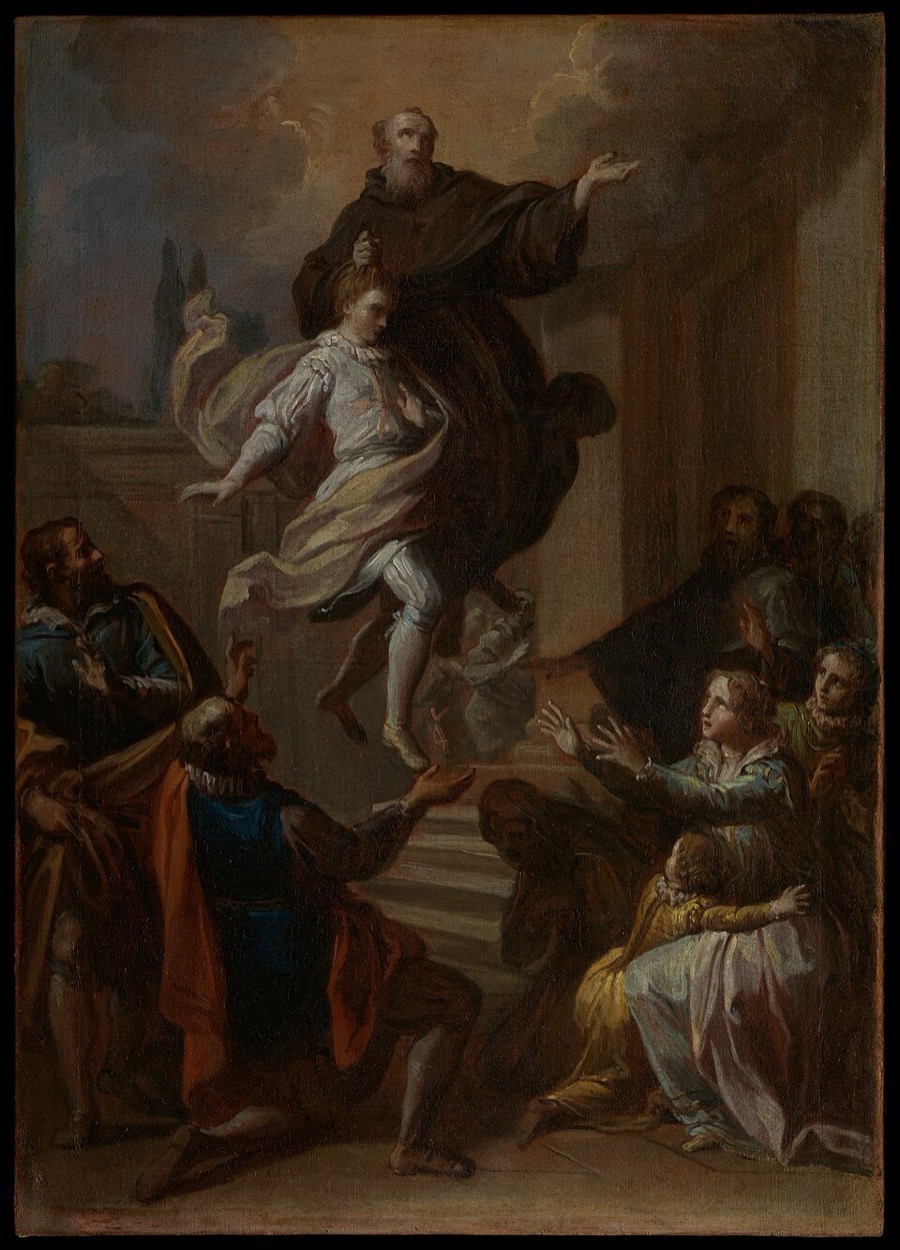
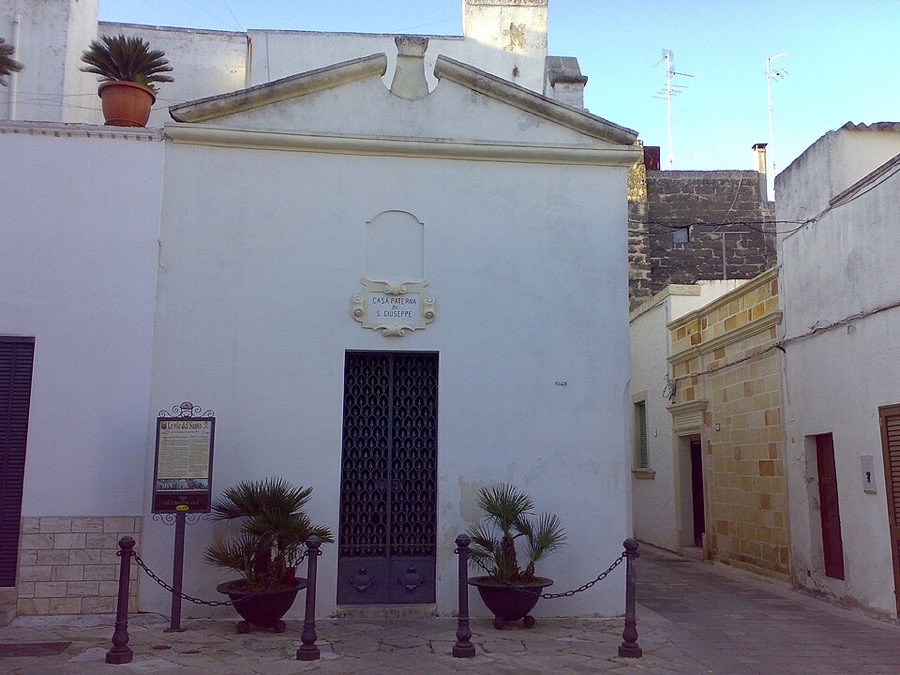
No portrait from life was confirmed.
Reported events
Raised from his chair during a cautery, 1663
In Joseph's last illness at Osimo, the surgeon Francesco Pierpaoli was cauterizing his right leg when he saw him lose all awareness and rise nearly a palm above the chair. Pierpaoli could not lower the leg, and a fly stayed on Joseph's open eye. Fr Silvestro Evangelista recalled him by obedience, and Joseph said he had felt nothing.
osservai, che era sollevato quasi un palmo alto dalla detta sedia (I saw that he was raised almost a palm high above the said chair; translation by this archive)
vedessimo chiaramente ambedue (we both saw clearly; translation by this archive)
Reported by Francesco Pierpaoli, his surgeon, who names the physician Giacinto Carosi as present. Recorded Testimony on events of 1663, printed by Bernini in 1722.
This is the closest record of his levitation found so far: a named medical witness, in his own words, naming a second physician and a third witness. It reaches us through a biographer writing for the cause, and Carosi's and Silvestro's own statements have not been read. Pierpaoli describes a man in a deep trance who felt no pain from a hot iron, which is the better supported part. The rise of a palm's width is a short distance to judge beside a seated, rigid patient.
A named surgeon speaks in his own words and names a second physician, but the original cause volume has not been read and the attestation is not shown as sworn. Levitation goes against known physics, so the event stays in the lowest band. The trance and insensitivity are far better supported. Reviewer's judgment, not a calculation.
Sources: Attestation of the surgeon Francesco Pierpaoli, as printed in Bernini's Vita; Vita del ven. padre fr. Giuseppe da Copertino de' Minori conventuali
Flight at Naples under Inquisition orders
While saying Mass at the chapel of San Gregorio Armeno during his Inquisition summons, he is said to have flown to the altar with a cry and stood among the candles while nuns shouted that he would catch fire.
he suddenly rose with a loud cry from a corner of the chapel, where he was praying, flew up to the altar
Reported by Pastrovicchi, drawing on the canonization processes; repeated in parish tradition. Recorded Printed 1753, from process testimony; date of underlying deposition not confirmed.
This is the claim most often said to have happened 'before the inquisitors'. Pastrovicchi's text says nuns were the witnesses, while a 2013 parish bulletin says inquisitors saw it on 27 November 1638. We could not reach the Naples file or the deposition, so the scene remains second hand here. Gordon Stein argued that Joseph's most impressive flights were not recounted by any eyewitness and were recorded after his death.
Known through a 1753 digest of canonization testimony, with the depositions unread. The sources disagree on whether nuns or inquisitors saw it. Known here only through a summary, so lowered by about 10. Reviewer's judgment, not a calculation.
Sources: Saint Joseph of Copertino; Joseph of Cupertino; Sotto il campanile, March 2013, in Comunita in Dialogo
Raised before Pope Urban VIII
Kissing the pope's feet in Rome, he is said to have been lifted up until the minister general ordered him down. Urban is said to have offered to bear witness if Joseph died in his reign.
was enraptured and raised aloft till the Father General's command brought him back to his senses
Reported by Pastrovicchi, citing the processes. Recorded Printed 1753.
An encounter between Joseph and the minister general at Rome is plausible from the record of his movements in 1639. We found no independent papal or curial record of the event. Urban's remark depends on the same tradition.
The meeting at Rome is plausible, but no papal or curial record of a levitation was found. The depositions behind Pastrovicchi were not read. Known here only through a summary, so lowered by about 10. Reviewer's judgment, not a calculation.
Sources: Saint Joseph of Copertino
The Spanish ambassador at Assisi, 1645
In 1645 the High Admiral of Castile, Spanish ambassador to the papal court, is said to have seen Joseph fly about twelve paces over the heads of those present to a statue of the Immaculate Conception, with the admiral's wife and retinue watching.
he flew about twelve paces over the heads of those present to the foot of the statue
Reported by Pastrovicchi, citing the processes. Recorded Printed 1753.
This is a strong type of story because it names high-status outsiders. We could not locate the admiral's own letter or diary, or a deposition in his household's name. A search in Spanish embassy papers could test it.
High-status outsiders are named, but only through the 1753 digest, and no letter or deposition of theirs was located. A search of embassy papers could raise the testimony score. Known here only through a summary, so lowered by about 10. Reviewer's judgment, not a calculation.
Sources: Saint Joseph of Copertino
The Duke of Brunswick's conversion, 1649
Pastrovicchi says Johann Friedrich of Brunswick, a Lutheran prince then 25, watched Joseph rise about five paces at Mass at Assisi in 1649, and that the experience moved him towards Catholicism. His attendants are said to include one Catholic and one Protestant.
with a loud cry rose in kneeling posture about five paces into the air
Reported by Pastrovicchi, citing the processes. Recorded Printed 1753.
The duke's later conversion to Catholicism is a historical event, and reviews report that Eire discusses the episode, so it has outside anchors. Pastrovicchi calls him Frederick; reviews of Eire call him Johann Friedrich. Whether the duke himself ever described a levitation in surviving papers I could not confirm.
The duke's conversion is a historical anchor and a Protestant attendant is mentioned, so this sits one step higher than the other flights. No statement by the duke himself was confirmed. Known here only through a summary, so lowered by about 10. Reviewer's judgment, not a calculation.
Sources: Saint Joseph of Copertino; Would you believe? Yale historian reconsiders the seemingly impossible (on Carlos Eire, They Flew: A History of the Impossible, Yale University Press, 2023)
Knowledge of distant events and deaths
Biographers credit him with foretelling deaths, including those of Urban VIII and Innocent X, and with reading consciences.
could be adduced on sworn testimony of trustworthy witnesses
Reported by Pastrovicchi, citing sworn testimony. Recorded Printed 1753.
Generic to the genre, and only as strong as unseen depositions. Pastrovicchi says such things could be shown on sworn testimony, but gives summaries.
Summaries only, with sworn testimony promised but not shown. Hits are remembered, and predicting the deaths of old popes takes little. Known here only through a summary, so lowered by about 10. Reviewer's judgment, not a calculation.
Sources: Saint Joseph of Copertino
Disputes
- He was denounced to the Inquisition at Naples for attracting crowds as 'another Messiah', according to Pastrovicchi, and spent his later life under imposed seclusion.
- Gordon Stein wrote in Skeptical Inquirer (1989) that the most impressive alleged levitations were not recounted by eyewitnesses and were recorded after his death. Joe Nickell (2018) argues he was an agile man who leapt. These views are reported in Wikipedia's entry, and we did not open the original articles.
- Sources disagree on what happened at Naples: Pastrovicchi has nuns as witnesses, a 2013 parish account has inquisitors, and an Italian article places an inquiry under Innocent X at Rome.
- Carlos Eire argues historians should weigh such testimony by normal criteria. Reviews of his book were mixed, as a Cambridge roundtable notes; We saw this only in search results, not the reviews themselves.
Still unknown
- What the depositions say in full. Parisciani's 1964 and 1996 studies drew on process files, reported as held in the Vatican Apostolic Archive. We saw neither study.
- Whether the Naples Holy Office file for 1638 survives. The Archivio Storico Diocesano di Napoli holds a Sant'Ufficio fonds, reported as open since 1970; Joseph's file has not been confirmed there.
- Whether Roberto Nuti's 1678 life can be read online. We found no scan.
- The wording of Prospero Lambertini's views as promoter of the faith. Pastrovicchi says Benedict XIV required citation of the processes.
Records
Sources
primary
hagiography
scholarly
reference