Regarded by the Longhouse people as the prophet of the Gaiwiio, the Good Message, which is still recited at Six Nations communities. Not a saint in any Christian sense.
A Quaker eyewitness recorded the first visions in his journal within days, and the original survives with page scans. Handsome Lake himself left no writing.
Henry Simmons journal, Vol. 2, 1799 (written 16 years before their death)
Paper trail
Where they came from
Conawagas (Ganawages, Canawaugus), on the Genesee River opposite Avon, New York, USA (traditional)
Allegany River, Cold Spring, Tonawanda
Onondaga Reservation near Syracuse, New York, under a monument photographed for Parker in 1913. Present use and access not confirmed.
Noble Seneca family. Turtle clan by Parker, raised by the Wolves; Wolf clan in other accounts. Half-brother of the war chief Cornplanter. A chief, not from a line of prophets.
No teacher. Hereditary title and Seneca ceremonial life. Close contact with Quaker teachers at the moment of his visions. Followers point to 15 June 1799.
War and burning of Seneca towns, loss of the Genesee lands, confinement, whiskey, and years of his own illness and drinking.
Cornplanter called a council the same day. Recitation spread through the Six Nations, and Jefferson's letter of 1802 was treasured by followers as an endorsement (a detail seen via Founders Online editors in a search listing).
Life
Handsome Lake was a Seneca of a noble family holding the title his name translates. Arthur Parker, drawing on tradition, gives his birth as 1735 at Conawagas on the Genesee. He lived through the destruction of Seneca towns in the Revolutionary War and the loss of the Genesee country. By the 1790s he was on the Allegany River, near his half-brother Cornplanter, ill and by tradition and his own account a heavy drinker.
On 15 June 1799 he collapsed and lay as if dead. Henry Simmons, a Quaker teacher living in Cornplanter's town, heard the account and attended the council called that day. More visions followed that summer, including a journey with a guide. Handsome Lake preached against whiskey, witchcraft and the breaking up of families, kept the great ceremonies, and accepted farming and some Quaker ways.
He went to Washington in 1802, and Jefferson wrote to him on 3 November endorsing his stand on liquor. His authority also divided the Seneca. Secondary summaries report a break with Red Jacket and later with Cornplanter, and deaths from witch accusations made under his influence. He died at Onondaga in 1815. His teachings were recited by successors, and the form Parker printed in 1913 comes from Edward Cornplanter.
they requested me to tell them whether I believed it to to be true.
they totally refrained from the use of ardent spirits for about nine years, and that none of the natives will touch it.
the lands you then held would remain yours, and shall never go from you but when you should be disposed to sell.
Images
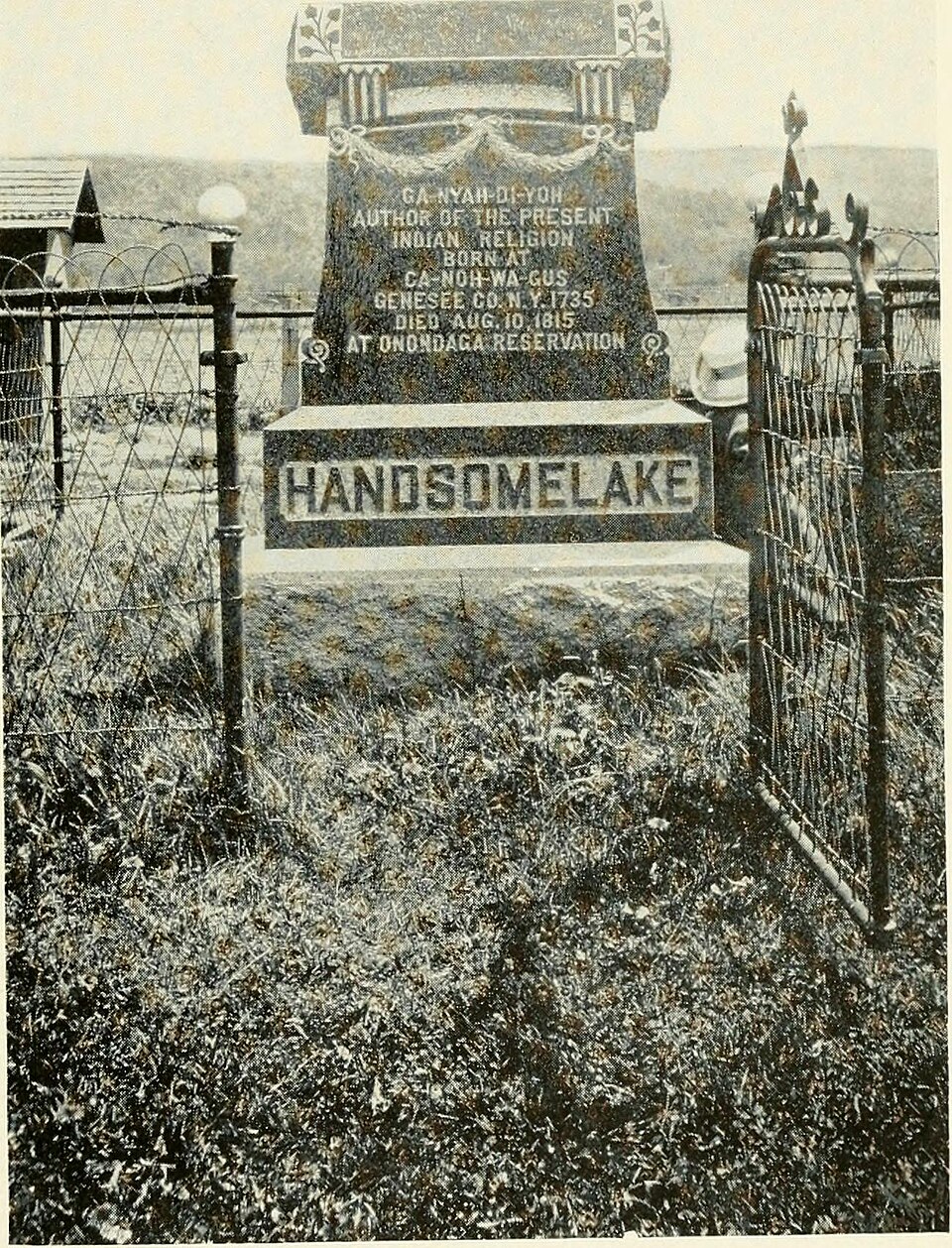
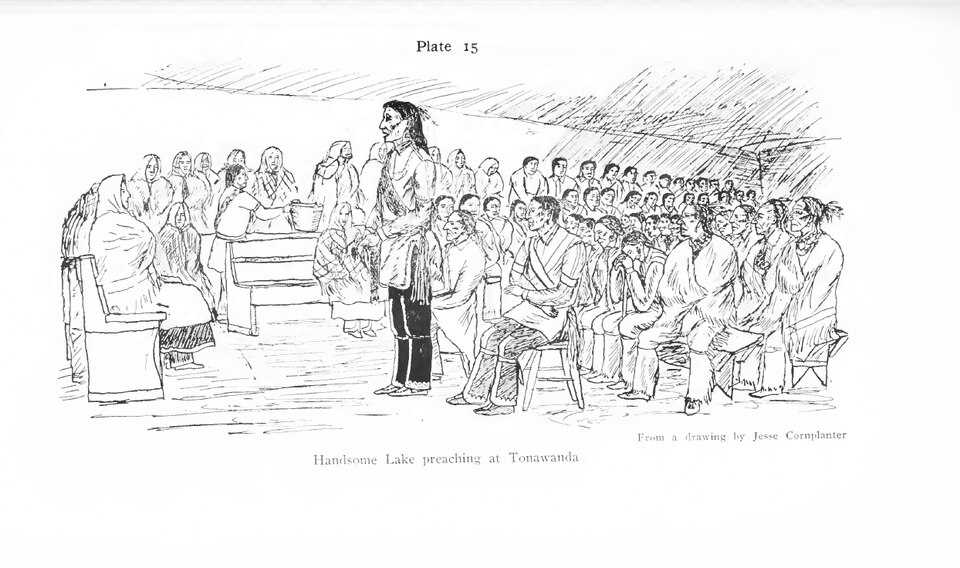
No portrait from life is known to me. Simmons page scans are in records/ but their reuse terms need asking from Haverford, so they are not used as book images.
Reported events
Lying breathless, then the three messengers
Handsome Lake was found breathless for about half an hour and revived about two hours later. He said three men with berry bushes had met him, told him the Great Spirit was displeased with drunkenness and other evils, and required him to stop drinking.
his brother laying breathless for the space of half an hour, but in about 2 hours after he came to himself again
Reported by Henry Simmons, Quaker teacher, from Cornplanter and the council he attended the same day.. Recorded Journal entry dated Sixth Month 15th, 1799..
This is unusually close: a non-Seneca wrote it within days and attended the council. Simmons did not see the collapse. He told the Seneca he thought it could be true, while adding that the man might not recall it exactly. Long illness and alcohol are the obvious natural context, and Simmons records he had been declining for years. Parker's Code gives the fuller community version, with four messengers and later development.
The collapse, the revival and his report of the messengers were written down by a Quaker within days, from Cornplanter and the council. Scored is the half hour without breath, which nobody measured and Simmons did not see. Reviewer's judgment, not a calculation.
Sources: Henry Simmons journals, Vol. 2, 1799 (transcription and scans); Henry Simmons journals: the note made at Cornplanter's
The sky journey and the canoes of whiskey
In a later trance a guide took him on a journey. He saw his dead son and his niece, was shown canoes loaded with kegs of whiskey and an ugly figure, and was told that whiskey was not made for Indians.
saw many Canoes loaded with Kegs of Whiskey
Reported by Handsome Lake, as rehearsed in council and noted by Henry Simmons the next morning from Cornplanter.. Recorded Simmons, 1799, within days..
Simmons says he went to Cornplanter's the morning after to make a note of the sick man's sayings, so the text is a dictated summary at one remove and in translation. The description of the whiskey trade was literally true of the Allegany in 1799, as Simmons's own entries show. Quaker influence on the contents is possible; Simmons's report of what he told the Seneca shows how directly the ideas met.
Event scored: the trance as an experience and his telling of it. A neutral outsider noted his words the next morning, at one remove and in translation. Reviewer's judgment, not a calculation.
Sources: Henry Simmons journals, Vol. 2, 1799 (transcription and scans); Henry Simmons journals: the note made at Cornplanter's
The berries and the warning of sickness
The messengers said he would live to see certain berries ripe that summer, which he later said had come to pass. A guide warned of great sickness in the village unless the people changed, and prescribed a white dog ceremony.
their would be shortly great sickness in their Village, unless they did amend their ways
Reported by Henry Simmons recording the council.. Recorded 1799..
Simmons recorded both the prediction and the Seneca response, including the white dog rite that afternoon, which he describes as an eyewitness. Simmons gives no record of what sickness followed. The berry prediction was a modest and likely outcome, and a warning conditional on repentance is hard to test.
The words are recorded within days, which is rare for a prophecy. The berry prediction was modest and likely, and the warning was conditional, with no record of what followed. Reviewer's judgment, not a calculation.
Sources: Henry Simmons journals, Vol. 2, 1799 (transcription and scans)
Detecting witches
Handsome Lake was reported to identify witches through his visions, and accusations under his influence led to punishments and deaths.
some very bad ones among them, who would poison others, but one of them was lately killed
Reported by Parker's introduction and Code; Simmons on the first day.. Recorded Parker 1913; earlier Quaker and agency papers not read by me..
The Code itself treats witchcraft as a grave evil, and Simmons's journal has the 1799 message saying a poisoner had been killed and one like her remained. That entry shows the theme from the very first day. Detailed cases come from works I did not open, so the specifics here are thin.
The 1799 journal shows the theme on the first day. The detailed cases of accusation and punishment were not read, so that part is thin. Reviewer's judgment, not a calculation.
Sources: Henry Simmons journals, Vol. 2, 1799 (transcription and scans); The Code of Handsome Lake, the Seneca Prophet
Called to Onondaga: the foretold last journey
The Code says the four messengers told him to prepare for a journey to Onondaga, and that he knew he was going to his new home. He died there on 10 August 1815. The Code also teaches that the faithful will die in their sleep while in health, and a note by Parker says some Onondaga followers repudiated him because he did not die that way.
Soon I will step into the new world for there is a plain pathway before me leading there.
Because Handsome Lake did not die in this manner some of his half believing followers at Onondaga repudiated his teaching.
Reported by Edward Cornplanter (Sosondowa), authorised preacher of the Gaiwiio, in the text Parker printed.. Recorded Recited tradition; printed 1913, about a century after the event..
The death date and place are firm, and the monument agrees. The journey being his last is known only from the recital, which was shaped after the fact. Parker's footnote records doubt among followers at the time, which is noteworthy in a work built on a community text. An old, sick man travelling and expecting death is not unusual.
The death at Onondaga is firm. That he foretold it is known only from a recital printed a century later, and an old, sick man expecting death needs no explanation. Reviewer's judgment, not a calculation.
Disputes
- Witch accusations under his influence are reported to have led to deaths and to have divided the Seneca. We rely here on summaries, not on the original Quaker and agency papers.
- Red Jacket is reported to have accused him of manufacturing his visions, and he in turn denounced Red Jacket. We saw this in search summaries only, and it needs checking in Wallace, The Death and Rebirth of the Seneca.
- The Code's own account differs from Simmons's. Parker's text has four messengers and many later teachings; Simmons's has three who came and one to come. Followers hold the recited Gaiwiio as the authentic form, and outside scholars read the 1799 journals as the earliest stage.
- Oral versions vary. Parker printed one holder's version, Edward Cornplanter's, translated mainly by William Bluesky, a Baptist lay preacher. It should not be read as the single text of the Longhouse people.
- How far Quaker teaching shaped the message is an open question. Simmons's journal shows the Quakers present and consulted from the first day; the Code presents the revelation as its own.
Still unknown
- His birth year: 1735 rests on tradition and the monument.
- Handsome Lake's own message to Jefferson of 1802, which Founders Online editors note has not been found, as seen in a search listing only.
- How Longhouse communities today wish the Gaiwiio to be presented in print; this should be asked, not assumed.
- Which Halliday Jackson version is closest to events; several differently worded copies exist at the American Philosophical Society, Haverford and Chester County.
- Wallace's edition of Jackson's journal and The Death and Rebirth of the Seneca, which we did not open.
Records
Sources
primary
hagiography
reference