Beatified 5 December 1965 and canonized 9 October 1977 by Paul VI.
Nothing written by him is known. Papal decrees are firm for the cause, but his life is told from monks' memory gathered from 1926.
Monastic testimony gathered in the ordinary process of 1926-28; no earlier source seen (28 years after death)
Paper trail
Where they came from
Bekaa Kafra, Lebanon (Ottoman Mount Lebanon region) (documented)
Monastery of Saint Maron and hermitage, Annaya, Lebanon
Monastery of Saint Maron, Annaya, a major shrine for Christians and Muslims.
Mountain peasants. Wikipedia reports his father Antoun was a mule driver who died in 1831 after forced labour for the Ottoman army. Two uncles were monks.
Lebanese Maronite Order, under Nimatullah Kassab al-Hardini, himself later canonized. The turning point in tradition is his leaving home at night.
Loss of his father in childhood.
Villagers and monks in his lifetime, per Paul VI's homily, then reports from the tomb. The Maronite Order drove the cause.
Life
Youssef Makhlouf was a mountain boy from Bekaa Kafra in northern Lebanon. The 1965 papal brief describes one room for people and animals, a village school under a tree, and shepherding. His father died when he was small, and an uncle, Tanios, became guardian and opposed his monastic plans.
He left home at twenty-three for the Lebanese Maronite Order's monastery at Mayfouq, then moved to Saint Maron at Annaya. He made solemn vows in 1853, studied at Kfifan under Nimatullah Kassab al-Hardini, and was ordained at Bkerke on 23 July 1859.
After sixteen years in community he was allowed in 1875 to live at the hermitage of Saints Peter and Paul above Annaya. He stayed twenty-three years, eating once a day and working in the fields. He collapsed during Mass in December 1898 and died on Christmas Eve.
His fame grew after death, around reports of light and fluid at the tomb. An ordinary process ran from 1926 to 1928 and Pius XII opened the cause in 1954. Paul VI beatified him at the end of the Second Vatican Council.
Images
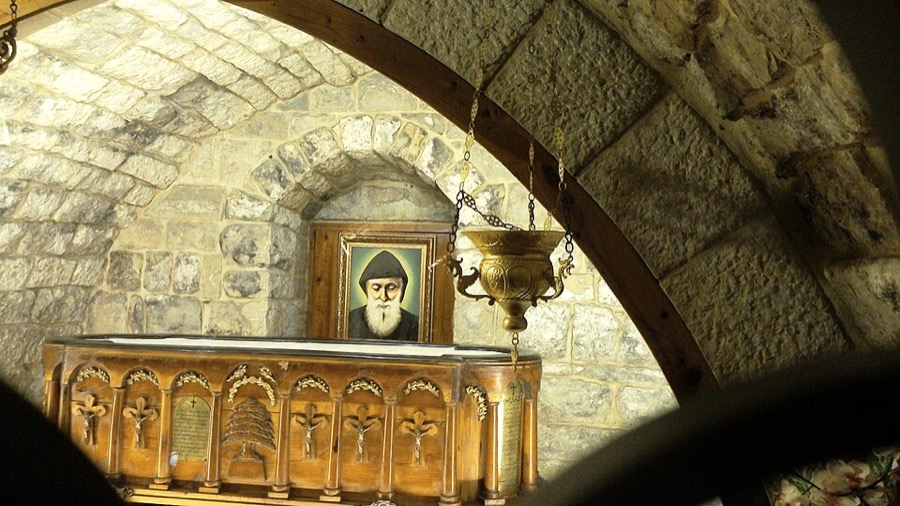
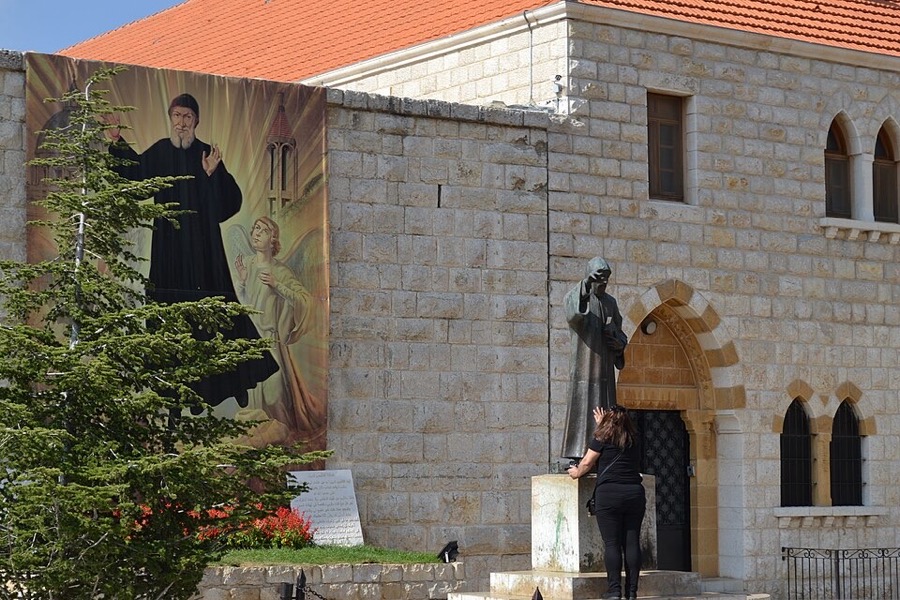
No image from life. A Commons file labelled as an old photo before 1898 was rejected: its own caption calls it a painting and Aleteia reports he was never photographed in life.
Reported events
Sister Mary Abel Kamari's ulcer
The Holy See accepted that a nun was instantly cured of a chronic gastric ulcer, after earlier surgery, at his intercession.
Constare de perfectis instantaneisque sanationibus
Reported by Sacred Congregation of Rites, on medical and process evidence. Recorded Decree of 23 November 1965.
The decree gives a precise diagnosis and is an official finding of a Church tribunal. Its dossier was not available to me, and the date of the cure is not in the text I read.
The decree is an official finding after a medical process, read directly, but the dossier and the date of the cure were not seen. All three Charbel cures score alike, because the evidence is alike. Known here only through a summary, so lowered by about 10. Reviewer's judgment, not a calculation.
Sources: Decree on miracles, and Tuto decree, in the cause of Sarbelius Makhlouf
Alexander Oubeid's eye
A Lebanese smith who lost the sight of his right eye through a blow, with retinal detachment, recovered it thirteen years later after invoking Charbel, according to the decree and decretal.
Reported by Sacred Congregation of Rites; Paul VI's decretal. Recorded 1965, 1977.
An official finding. Wikipedia names him Iskandar Naim Obeid of Baabdat. The primary medical file was not seen.
The decree and decretal name the man and the injury, but no medical file was seen. Recovery after thirteen years is striking as described, and the original loss of sight is unchecked. Known here only through a summary, so lowered by about 10. Reviewer's judgment, not a calculation.
Sources: Decree on miracles, and Tuto decree, in the cause of Sarbelius Makhlouf; Quamvis Libanus: Decretal letter of canonization
Mariam Assaf Aouad's throat cancer
A Lebanese woman of 57 with an undifferentiated epidermoid cancer of the right tonsil in 1966 is said to have recovered at once when Charbel was invoked.
Reported by Paul VI's decretal of canonization. Recorded Approved 3 October 1975, printed 1978.
Named in the decretal. Cancer cures are the strongest kind of case if biopsy and follow-up exist. The dossier was not available.
A named patient and a precise diagnosis, but the biopsy and follow-up were not seen. Those files could raise this score considerably. Known here only through a summary, so lowered by about 10. Reviewer's judgment, not a calculation.
Fluid from the tomb and the preserved body
Accounts say fluid seeped from the tomb in 1950, that the body looked lifelike at openings around 1950 to 1955, and that physicians examined it. By the 1976 opening only a skeleton remained, per Wikipedia.
Reported by Monks of Annaya, postulator Joseph Mahfouz, later devotional writers. Recorded Mid twentieth century; We read only later summaries.
Dates and details vary across the sources we found, and we could not reach the commission's report or the medical report said to date from 1927. The official shrine site's address now redirects to an unrelated domain, so it is not cited. Fluid from decaying tissue in a damp stone tomb is a natural candidate. The later collapse to a skeleton shows that the preservation was not permanent. Papal documents I read mention light over his tomb only as a figure of speech.
Dates and details vary, and neither the commission's report nor the medical report was reached. The later skeleton shows that any preservation did not last. Known here only through a summary, so lowered by about 10. Reviewer's judgment, not a calculation.
Sources: Charbel Makhlouf
The 1950 photograph
Aleteia reports that on 8 May 1950 a group photo at Annaya showed an unknown monk, and that older monks recognised Charbel. Most modern portraits are said to derive from it.
Reported by Fr George Webby's party, in a devotional retelling. Recorded Article of 2025; earliest telling not found.
Aleteia also says he was never photographed in life. We found no negative, forensic study or early printed account. Double exposure or an unnoticed monk are the obvious candidates.
First reached in a 2025 devotional article, with no negative or early printing. A double exposure or an unnoticed monk would produce the same picture. Reviewer's judgment, not a calculation.
Disputes
- Sources disagree on how often the tomb was opened and when: some say 1950 and 1952, others four openings up to 1955, and a claim of physician examination in 1927.
- The 'incorrupt body' fame ended with the skeleton found in 1976, per Wikipedia, while the devotional literature often omits this.
- Wikipedia dates his cause to 1929; the 1977 decretal gives an ordinary process from 1926 to 1928 and an opening of the cause in 1954. The official text is followed here.
- The face on countless icons comes from a disputed 1950 photograph, not from any portrait from life.
Still unknown
- The Order's Annaya register and the reports of the tomb openings, in the archive of the Lebanese Maronite Order.
- The apostolic process files and medical dossiers, in the Dicastery for the Causes of Saints, Rome.
- Any Ottoman-era or press record from 1898 to 1950. We found none.
Records
Sources
primary
reference