Baha'is regard him as the Manifestation of God for this age and the one foretold by the Bab. Azali Babis rejected his claim. Ottoman officials judged it a danger to public order in 1868.
He left a vast body of his own writing, and Ottoman, British and missionary records were made during his lifetime, plus Browne's eyewitness account. Reports of wonders come almost entirely from devoted followers and are not stressed by the community itself.
His own writings of the 1850s and consular dispatches from Baghdad from 1858 (written 34 years before their death)
Paper trail
Where they came from
Tehran, Iran (documented)
Baghdad, Edirne and 'Akka, all in the Ottoman Empire, in exile from Iran from 1853
Shrine of Baha'u'llah at Bahji, near 'Akka, Israel; the most holy Baha'i pilgrimage site
Nuri family of notables from Mazandaran. Father Mirza 'Abbas (Mirza Buzurg) served the Qajar court. A landed, courtly family, not a clerical one. Several brothers joined the Babis.
No madrasa training is recorded in the sources read. Cole notes contact with Shaykhis, conversion through Mulla Muhammad Mu'allim in 1844, and the dungeon of 1852 as the turning point followers point to. He lived as a dervish among Khalidi Naqshbandis in Sulaymaniyya.
His father's fall from power, the massacres of the Babis, the dungeon, confiscation of family property, four successive exiles, and the death of followers in the 'Akka citadel.
Babis in Iraq looked to him in the 1850s. He declared himself to a few followers in April 1863 at the Garden of Necip Pasha, later the Ridvan garden of Baha'i tradition, then openly at Edirne. Letters carried by disciples brought most Babis in Iran over to him by the early 1870s.
Life
Mirza Husayn-'Ali was born in Tehran in 1817 to a notable family from Mazandaran. His father, Mirza 'Abbas Nuri, served the Qajar court and fell from favour. He refused a government career, joined the Babis in 1844, used his rank to protect them, and took the name Baha at the Badasht gathering of 1848.
After Babis tried to kill Nasiru'd-Din Shah on 15 August 1852, he was chained in the Siyah-Chal dungeon in Tehran, found innocent according to Cole, and exiled. He left Iran in January 1853 and reached Baghdad; Momen gives 8 April 1853, and Iranica gives 12 January. He withdrew for two years to Kurdistan (1854-56) in the manner of a Sufi dervish, because of friction with his half-brother Subh-i Azal, and returned to lead the Babis in practice. British Consul Kemball wrote in 1859 that he enjoyed a devotion near to reverence.
Persian pressure moved him to Istanbul in 1863, then Edirne, where he openly claimed to be the one foretold by the Bab and broke with Azal. An Ottoman commission found in June 1868 that he claimed to be the Mahdi and to reveal verses, and the Sultan's order sent him to 'Akka and Azal to Cyprus. He arrived on 31 August 1868, was held in the citadel for over two years, then under house arrest, and from 1877 lived outside the walls, at Mazra'a and then Bahji, where he died in 1892. In these years he wrote to world rulers and set down the Kitab-i-Aqdas, about 1873.
Browne met him in April 1890. Miracle claims have an unusual status among Baha'is. 'Abdu'l-Baha said Baha'u'llah did many wonderful things but declined to recount them, since accounts of miracles prove nothing to those who did not see them. Baha'i teaching keeps the possibility while discouraging reliance on it, and offers his writings and influence as the proof. Baha'i histories do include wonders, but the tradition does not build its case on them.
Those piercing eyes seemed to read one's very soul; power and authority sat on that ample brow.
Yes, miracles are proofs for the eyewitness only, and even he may regard them not as a miracle but as an enchantment.
We desire but the good of the world and the happiness of the nations; yet they deem us a stirrer up of strife and sedition worthy of bondage and banishment.
many wonderful things were done by Baha'u'llah, but we do not recount them, as they do not constitute proofs and evidences for all the peoples of the earth
Images
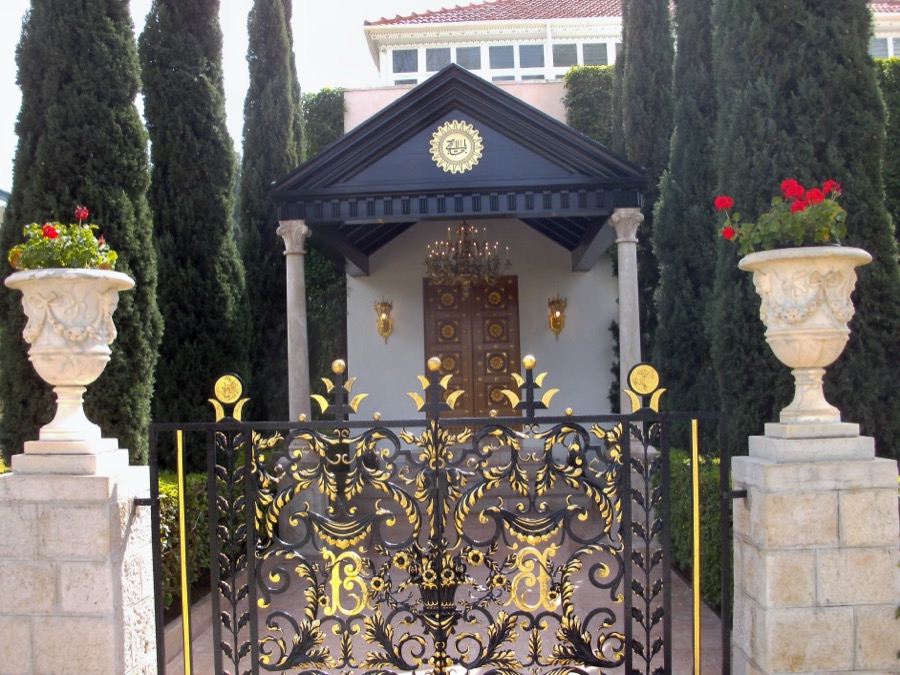
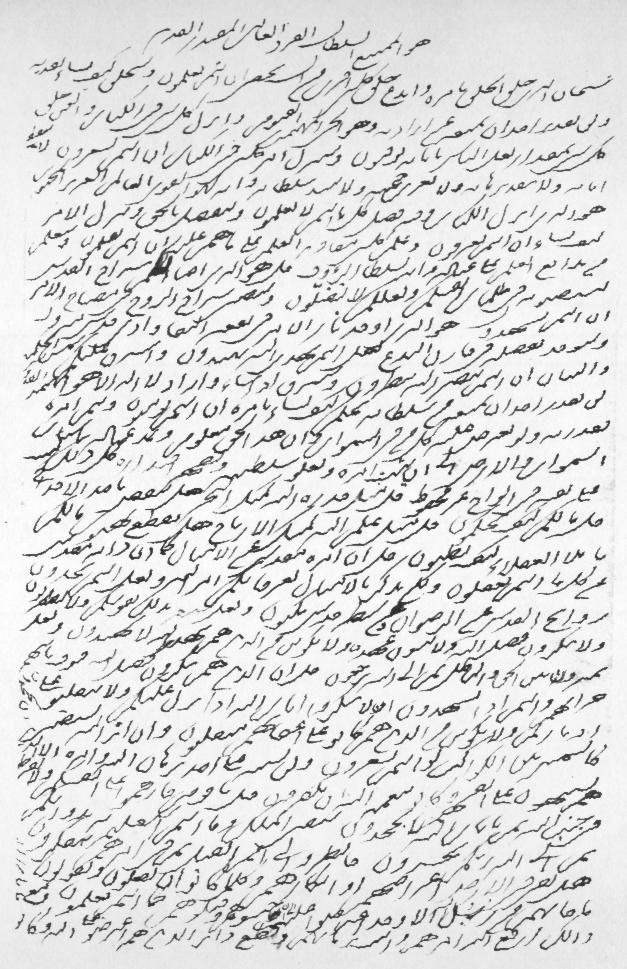
No portrait or photograph is used. Baha'is treat images of Baha'u'llah with great reverence and do not display them casually, so no likeness has been saved. The card uses his shrine and a manuscript of one of his writings. Note that the Suriy-i-Amr scan is 627 pixels wide, too small for full-page print, and its CC0 tag rests on the Commons uploader; the 1866 text itself is long out of copyright.
Reported events
The vision in the Tehran dungeon
Baha'u'llah wrote that while chained in the Siyah-Chal dungeon in 1852 he had mystical experiences, and he resolved there to regenerate the Babi community. Baha'is date his mission to this time.
Reported by Baha'u'llah himself. Recorded Late account in the Epistle to the Son of the Wolf, about 1891.
First person, but the account read here was written nearly four decades after the event, when his claim was long established. The fact of his imprisonment is well attested. Cole notes he had visionary dreams there and kept a messianic secret for years. Nothing about the inner experience can be tested.
Event scored: the dungeon experience as an experience. The imprisonment is solid, but his own account was written nearly four decades later, with his claim long established. Reviewer's judgment, not a calculation.
Sources: Epistle to the Son of the Wolf; BAHA'-ALLAH; The Babi and Baha'i Religions, 1844-1944: Some Contemporary Western Accounts
The challenge to the Baghdad clerics
'Abdu'l-Baha relates that the clerics of Iraq sent Hasan 'Amu to ask for a miracle. Baha'u'llah agreed on condition that they choose one miracle together and seal a pledge to accept him if it happened. They declined, fearing enchantment.
Although you have no right to ask this, for God should test His creatures, and they should not test God, still I allow and accept this request.
Reported by 'Abdu'l-Baha, his son, who was a teenager in Baghdad; repeated by Shoghi Effendi. Recorded 1908, table talk recorded some four decades after the event.
This is the key Baha'i story about miracles, and it is told as a miracle that was never performed. It comes only from Baha'u'llah's family and community. No clerical or Ottoman record of it was found. The story's purpose is to show that miracles are beside the point. Its condition, a sealed agreement in advance, can be read as a fair test or as a safe way to avoid one.
Told by his son forty years later, and found in no clerical or Ottoman record. The exchange is ordinary, but only one side reports it. Reviewer's judgment, not a calculation.
Sources: Some Answered Questions; God Passes By; Miracles
The Mosque of Sultan Selim test with Subh-i Azal
At Edirne about 1867 a test of truth (mubahala) was arranged between Baha'u'llah and his half-brother Mirza Yahya, Subh-i Azal, at the Mosque of Sultan Selim. Baha'i sources say Baha'u'llah went and his brother failed to appear.
Reported by Mirza Jawad of Qazvin, Baha'i eyewitness to part of the affair; Baha'u'llah's tablets and other Baha'i memoirs cited by Cole. Recorded About 1898 (Mirza Jawad).
Mirza Jawad says he was present when the sealed tablet was handed over. Cole's account, drawn from Baha'i sources, says it was Yahya who issued the challenge, while Mirza Jawad has it arranged through Mir Muhammad, a go-between. An Azali version was not read. Nothing supernatural is described except the claim that Baha'u'llah chanted verses aloud in the streets, to general astonishment.
A partial eyewitness writes about thirty years later, from one faction. Sources differ on who issued the challenge, and no Azali version was read. Reviewer's judgment, not a calculation.
Sources: An Epitome of Babi and Baha'i History to A.D. 1898 (Mirza Jawad of Qazvin); BAHA'-ALLAH
Survival of poison at Edirne
Baha'i sources say that at Edirne Mirza Yahya gave Baha'u'llah poisoned tea. He fell gravely ill and recovered, and a physician called Dr Chilpan is said to have prayed to take the sickness on himself and then died.
And it seemed as though his prayers were answered, for he fell sick and was confined to his house.
Reported by Mirza Jawad of Qazvin and Baha'u'llah himself, as cited by Cole. Recorded About 1898; Baha'u'llah's own charge dates from the 1860s.
Mirza Jawad does not say he saw it. Cole reports Baha'u'llah's charge, and adds that Azal in turn accused him of a similar plot. The illness is credible, but poisoning has not been established by any medical or official record found here. This is one faction's accusation against the other.
Scored is the poisoning, not the illness, which is credible. It is one faction's charge with no medical record, and the same score goes to the Nursi prison poisonings. Known here only through a summary, so lowered by about 10. Reviewer's judgment, not a calculation.
Sources: An Epitome of Babi and Baha'i History to A.D. 1898 (Mirza Jawad of Qazvin); BAHA'-ALLAH
The prayer against sickness at 'Akka
After the exiles reached 'Akka in 1868, many fell ill and three died. Mirza Jawad writes that Baha'u'llah issued a prayer and that after they had recited it for some time, health returned.
And after they had continued to read it for a time, matters improved and health and healing resulted, by the abounding Grace and Mercy of God.
Reported by Mirza Jawad of Qazvin, a Baha'i memoirist of the period; it is not clear from these pages that he was at 'Akka in 1868. Recorded About 1898.
A follower's memoir, three decades later, with no medical record. He himself reports the deaths and says conditions in summer were very bad. Illness passing with time needs no special cause, and he claims only gradual improvement. This is the nearest thing to a healing report tied to Baha'u'llah in a first-generation source read here.
A follower's memoir thirty years on, and he claims only gradual improvement, which he himself sets beside deaths. The claim is modest and no medical record exists. Reviewer's judgment, not a calculation.
Sources: An Epitome of Babi and Baha'i History to A.D. 1898 (Mirza Jawad of Qazvin); BAHA'-ALLAH
Cure of Mirza Aqa Khan
Nabil notes in passing that Baha'u'llah once cured Mirza Aqa Khan, the future chief minister of Iran, of an illness when he had given up hope of recovery.
Reported by Nabil-i-A'zam, Baha'i historian. Recorded 1887-1888.
One sentence, with no date, method or witness. Cole confirms that the two men were related and allied, but not the cure. Baha'u'llah's family was educated and of high rank. If it happened, the means is unknown.
One undated sentence with no method or witness. A recovery is ordinary, so the low score reflects how little is recorded. Reviewer's judgment, not a calculation.
Sources: The Dawn-Breakers: Nabil's Narrative of the Early Days of the Baha'i Revelation; BAHA'-ALLAH
Warning to Napoleon III
In a tablet written from 'Akka, Baha'u'llah told Napoleon III that his kingdom would be thrown into confusion and his empire would pass from him. Baha'is point to the fall of the Second Empire at Sedan in September 1870.
Reported by Baha'u'llah himself; the fulfilment is argued by Shoghi Effendi in 1941. Recorded Tablet of about 1869 according to Baha'i dating.
The tablet is his own, so the wording is first hand. The critical question is proof of date. Baha'i sources place it about 1869 in the 'Akka barracks. Rosen catalogued the Suratu'l-Haykal, in which the tablet was later placed, from a manuscript in Russia between 1876 and 1886, after the event, and no copy dated before September 1870 was found here. A warning of ruin to a ruler is also a familiar religious form, and the Baha'i World Centre says he foretold violent downfall for a few of the kings he addressed. Velasco has moved the date of the first tablet to about May 1868, which shows how much the dating depends on internal evidence.
His wording is first-hand, but no copy dated before September 1870 was found, and everything turns on that date. A fulfilled warning is scored only as far as the dating allows. Reviewer's judgment, not a calculation.
Sources: The Promised Day Is Come; Baha'u'llah's First Tablet to Napoleon III: A Research Note; The Babi and Baha'i Religions, 1844-1944: Some Contemporary Western Accounts; BAHA'-ALLAH; The Summons of the Lord of Hosts
Writing as the miracle
Followers described the speed and volume of his revealed verses as a sign. 'Abdu'l-Baha called the Tablets to the rulers a miracle. An American missionary reported that he claimed a miracle of writing a thousand letters in a very short time.
professes to work a miracle in proof of his divinity by writing a thousand letters in an incredible short space of time
Reported by Rev. James Bassett, American missionary in Iran, a hostile reporter; 'Abdu'l-Baha, as quoted by Shoghi Effendi. Recorded 1887 (Bassett, Persia, the Land of the Imams, p. 300, as cited by Momen).
His writings survive in great number, in Persian and Arabic, as Cole's citations show. The missionary's figure of a thousand letters is second hand and scornful. The speed itself cannot now be measured.
Event scored: very rapid and prolific writing. The surviving tablets prove the volume, while the speed rests on followers and a scornful second-hand report. Known here only through a summary, so lowered by about 10. Reviewer's judgment, not a calculation.
Sources: The Babi and Baha'i Religions, 1844-1944: Some Contemporary Western Accounts; God Passes By; BAHA'-ALLAH
Disputes
- Killing of Azalis at 'Akka, January 1872. A group of Baha'is killed three followers of Azal. Baha'i sources and Cole say this happened without his knowledge and that he denounced it, and Momen quotes his grief. Rev. John Zeller, a missionary at Nazareth, wrote in 1872 that they were killed by his order. That is an allegation by a hostile outsider. No court finding against him was found; Momen reports, from Shoghi Effendi, that he was held and then released as free of blame.
- Violence at Baghdad. Consul Kemball reported in 1858 and 1859 that Babis had killed two dervishes and attacked a mulla who gave offence, and implied that the chief was behind it. Momen identifies the first incident as probably the killing of two renegade Babis. Kemball's figures for followers (2,000 to 5,000) are far above the 50 or so in Baha'i accounts.
- Succession. Cole says the Bab appears to have named the young Azal to a high position. Baha'is say this was a ruse to shield Baha'u'llah. Azalis held that he usurped the leadership. Browne's sympathy drifted toward the Azalis, a move Momen criticizes.
- Cause of the 1868 exile. Baha'u'llah blamed the Persian ambassador Mirza Husayn Khan. The Ottoman file, as summarized by Momen, points to quarrels and accusations between Baha'is and Azalis in Istanbul and to the claims themselves.
- British protection. Baha'i sources say Kemball offered him British citizenship. Momen notes that Kemball's official reports do not mention this.
- Marriages. Cole records three marriages and two wives at a time, under Babi law, although Baha'i law later required monogamy.
- Eyewitness memories. Beveridge found discrepancies between Baha'i accounts of the journey to 'Akka and European archive records.
- Images. Baha'is restrict the display of his photographs. See imageNote.
Still unknown
- The Ottoman originals of File 1475 and the firman of 1868. The Prime Ministry Ottoman Archives in Istanbul should hold them, but the current shelfmark was not found.
- Whether any dated copy of the second tablet to Napoleon III exists from before September 1870. The Baha'i World Centre archives in Haifa are the place to ask.
- What Azali and Ottoman witnesses said about the Mosque of Sultan Selim episode.
- Whether Kemball wrote privately about offering protection. Momen points to the Layard Papers, British Library, Add. 38994-5 and related volumes.
- What became of any medical record of his illnesses at Edirne, or of the sickness at 'Akka in 1868. None was found.
Records
Sources
primary
contemporary
hagiography
scholarly
reference