Founder of the Muridiyya. Followers call him Serigne Touba and regard him as a saint and servant of the Prophet. His departure into exile is commemorated at the annual Magal of Touba.
Colonial files quote his letters from 1889, and his own Arabic writings survive. The miracle stories, by contrast, are mostly later tradition, apart from rumours French officials logged in his lifetime.
Letter to the Governor, July 1889, as quoted by Marty from the colonial files (written 38 years before their death)
Paper trail
Where they came from
Mbacké, Baol, Senegal (traditional)
Baol, Cayor and Djolof in Senegal; exile in Gabon and Mauritania
Touba, Senegal, beside the Great Mosque; one of the largest pilgrimage sites in West Africa and still heavily visited
Clerical family of Quran teachers. Father Momar Antasali (Momar Anta Saly) taught in Saloum and Cayor. Mother Diarra Bousso, called Mame Diarra, is herself venerated. Marty records Tukulor origin four generations back.
Taught first by his father. Marty treats him as a Qadiri and spiritual son of Cheikh Sidiyya, and reports that the French also believed he was linked to the Tijaniyya. Murid sources add a later direct mandate from the Prophet, which comes from the tradition.
The Wolof kingdoms collapsed around him: Lat Dior and Samba Laobé were killed in 1886 and Cayor was dismembered. Then came two exiles and about thirty-two years of surveillance.
Disciples gathered in the late 1880s, many of them people displaced by the fall of Cayor, according to Marty. The Gabon exile, read by followers as a divinely willed trial, greatly enlarged his reputation. Marty reports that the story spread within months of his 1902 return.
Life
Amadou Bamba came from a family of Muslim teachers in Wolof country. Paul Marty, the French colonial Islamic affairs officer, records that the family was of Tukulor origin four generations back, that the grandfather founded Mbacké in Baol, and that the father, Momar Antasali, was a Quran teacher who was carried off to Saloum during the wars of Ma Ba and later served near the damel Lat Dior.
French files first notice him in 1888 and 1889, when complaints reached Governor Clément Thomas about students leaving home and about disorder in Diambour. Marty quotes Bamba writing in July 1889 that he needed nothing from this futile world. He settled at Touba in Baol, drew disciples, and in 1895 moved into Djolof with several hundred followers.
He was arrested on 10 August 1895. On 5 September 1895 the Conseil privé at Saint-Louis ordered him interned in Gabon, where he stayed until 1902. Returned on the surety of Cheikh Sidiyya, he was sent to Mauritania in 1903, moved to Thiéyène in 1907, and to Diourbel in 1912 under watch.
By the 1910s the administration had moved from suppression to accommodation. Marty's 1913 report treats the Murids as a large organized force, and the colonial state came to rely on them for peanut production and order. He died at Diourbel on 19 July 1927 and was buried at Touba, where the Great Mosque now stands.
Je vous fais savoir [...] que je suis le captif de Dieu, et ne reconnais pas d'autre autorité que Lui.
Images
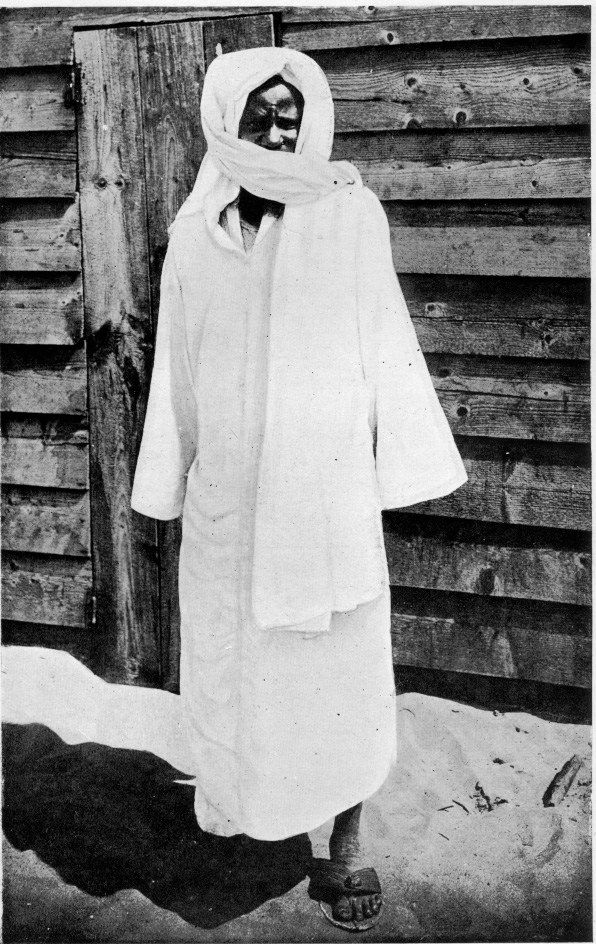
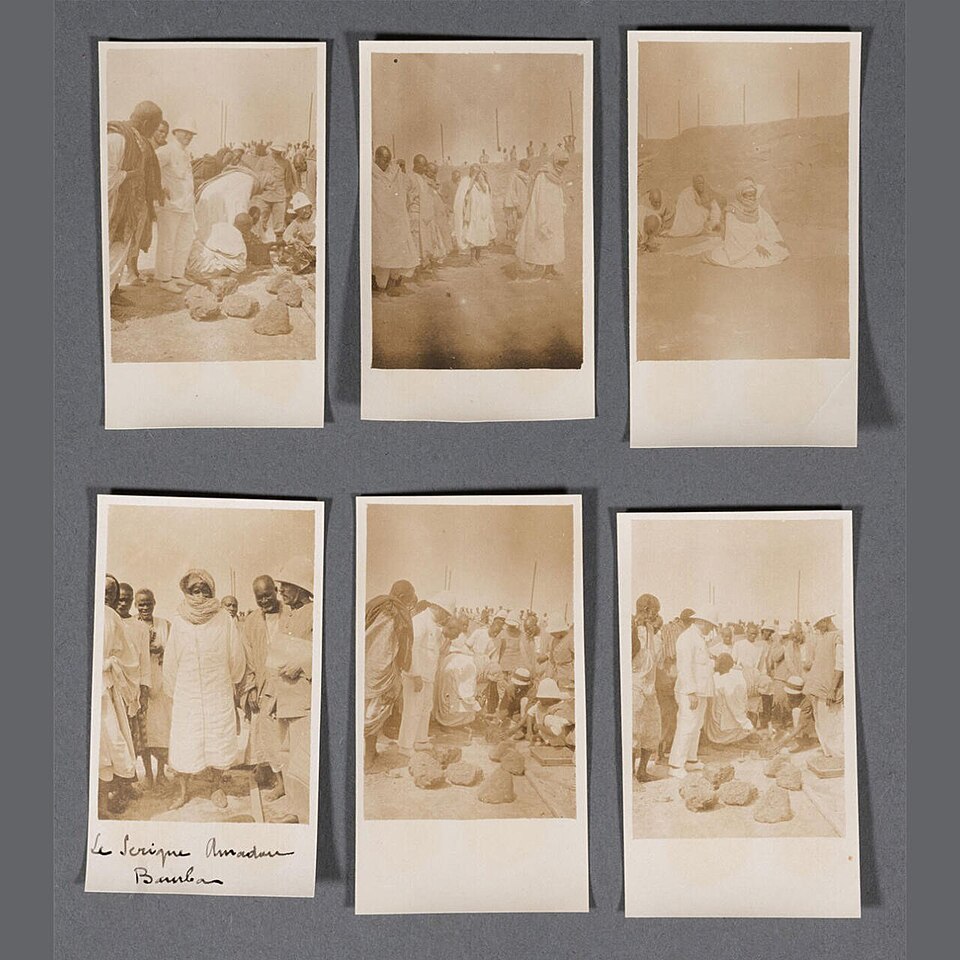
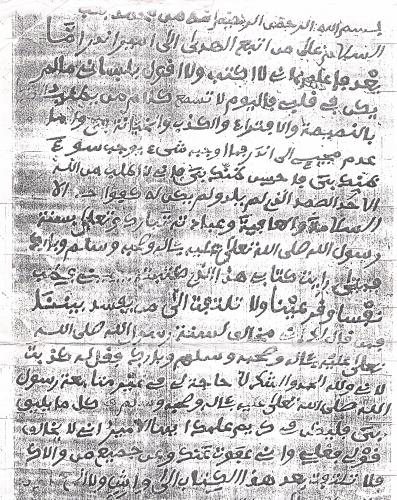
Murids treat the 1913 photograph as an object of devotion, and it is the source for most Touba wall paintings.
Reported events
Prayer on the ocean
Murid tradition holds that on the ship taking him to Gabon in 1895 he was refused a place to pray, spread his prayer skin on the sea, and prayed there while the ship waited.
Reported by Murid oral tradition and disciples, including the poet Serigne Moussa Ka; retold by Moustapha Samb in a modern Senegalese study. Recorded Twentieth century. Moussa Ka's account is the identified source, and its date was not established in this research..
No French document consulted here records it. Marty, who examined the files in 1913 and collected stories hostile and friendly, does not mention it, though he does report other Gabon legends. Samb states that the ordeals are confirmed by the Sheikh's own writings, but those passages were not checked here. It may be that a real dispute over prayer on board grew in the telling; that is a possibility and not a finding.
Scored low in the band because no named witness is reached and Marty, who collected Gabon legends in 1913, does not report it. The exile itself is documented. Known here only through a summary, so lowered by about 10. Reviewer's judgment, not a calculation.
Sources: Cheikh Ahmadou Bamba: résistant pacifique, conducteur d'âmes et libérateur culturel
Survival of the Gabon ordeals
Tradition lists a series of trials in exile: a furnace, a furious bull, a lions' cage, a well, a cell at Mayumba, and a firing squad on the beach. He is said to have come through each unharmed.
Reported by Serigne Moussa Ka's narrative, summarized by Moustapha Samb. Recorded Twentieth century, after his death or late in his life.
That he was held in hard conditions at Mayumba and Lambaréné is plausible and the exile itself is documented. The specific ordeals are not attested in the French sources consulted. Samb himself introduces some of them with the words of tradition. The Gabon administrative files were not reached and could test this.
The hard exile is documented, but the unharmed passage through furnace, lions and firing squad is not in any French source consulted. The Gabon files have not been read and could test this. Known here only through a summary, so lowered by about 10. Reviewer's judgment, not a calculation.
Sources: Cheikh Ahmadou Bamba: résistant pacifique, conducteur d'âmes et libérateur culturel; Études sur l'Islam au Sénégal, tome 1: Les personnes (ch. IV reprints Les Mourides d'Amadou Bamba)
The story of the wings, 1902 to 1903
Within three months of his return, a French report says, people were saying he had gone to Gabon by his own will after asking God for a great trial, and that he had thought of flying home on wings offered by the Prophet but declined out of modesty.
Il avait d'abord pensé revenir par les airs, avec les ailes que le prophète voulait lui donner ; mais par modestie il s'y était refusé.
Reported by Paul Marty, French officer, summarizing colonial reports of what Murids said. Recorded Marty's report of 1913, printed again in 1917; describing talk of about 1903.
This is valuable as dated evidence of a miracle belief in his lifetime, recorded by an unsympathetic official. It shows what people said, not that Bamba said it. Marty offers it as an example of agitation. There is no event here to test.
Event scored: that people were telling this story in 1903, which a hostile official recorded. Nobody claims to have seen it, and it is not shown that Bamba said it. Reviewer's judgment, not a calculation.
Sources: Études sur l'Islam au Sénégal, tome 1: Les personnes (ch. IV reprints Les Mourides d'Amadou Bamba)
The miracle he declined, 1903
When French police approached Mbacké in June 1903, Marty says, his elder brother Momar asked him to perform the plain miracle that would drive the French off. He refused, and Momar then opened contact with the column and submitted.
lui demanda d'accomplir le miracle patent qui devait éloigner les Français. Amadou Bamba s'y refusa
Reported by Paul Marty, drawing on administrative reports. Recorded 1913, about ten years after the event.
An unusual record: a colonial source showing that people around him expected miracles and that he would not attempt one. The informant is unnamed and the scene serves Marty's argument that the movement deflated under pressure. Marty also gives inconsistent dates for the 1903 events on the same pages (13 June and 19 May).
A colonial report written ten years later, with an unnamed informant and a motive to show the movement deflating. The scene itself is ordinary. Reviewer's judgment, not a calculation.
Sources: Études sur l'Islam au Sénégal, tome 1: Les personnes (ch. IV reprints Les Mourides d'Amadou Bamba)
Disputes
- Marty alleges that Murid followers took women and children into near slavery, cheated the credulous and seized land between 1910 and 1913. These are colonial allegations and he had an interest in showing a need for control.
- Marty also says Bamba handed the Governor the names of his most compromised disciples in 1891. No Murid source consulted confirms this.
- What happened at the Conseil privé of 5 September 1895 is disputed. The extract records no answers from Bamba. A letter published by Murid writers calls that omission a cover-up, which is the writer's assertion. Murid tradition holds that he prayed two rakaas before the council, and the minutes consulted in summary do not confirm that.
- Archivist Oumar Ba's reading is that holy war preaching was neither proven nor charged and that the internment was political. French officials at the time described it as a danger of agitation.
- The Legion of Honour: Samb says he received the diploma and refused to wear the cross. An uncited Wikipedia statement says he refused it in 1918. No decree was found here.
- Historians debate how far the Murid accommodation with France after 1912 was resistance or collaboration. David Robinson frames it as surveillance and collaboration; Samb rejects colonial historiography.
Still unknown
- His own Arabic poems on the exile (the Khassaids) were not read here. They would test which ordeals he himself described. Most manuscripts are reported to be at the library of the Great Mosque of Touba.
- The full 13 G dossier at the Archives nationales du Sénégal, and Oumar Ba's inventory of it, were not reached. CARAN microfilm 200 MI 894 reproduces ANS 13 G 67.
- The Gabon administrative archives (Libreville and ANOM, Aix-en-Provence) could show where he was held and how.
- His birth year is traditional and no civil record exists.
Records
Sources
contemporary
hagiography
scholarly
reference