Founding hero of modern Algeria, and honoured by France, Britain and others for 1860. Sufis regard him as a master in the school of Ibn Arabi. He has no formal religious canonization.
His own letters, a treaty he sealed, a dictated life, and independent British and French official reports survive. The mystical side rests on his works and students.
Acts of allegiance (mubaya'a) of 22 and 27 November 1832, reported at the Musée national de l'armée, Algiers (written 51 years before their death)
Paper trail
Where they came from
El Guetna (ketna of the Wadi al-Hammam), near Mascara, Algeria (coordinates approximate) (documented)
Western Algeria until 1847; France in captivity; Damascus from 1855
First at Salihiyya, Damascus, beside Ibn Arabi; since 1966 at El Alia cemetery, Algiers. Bouyerdene's volume says the empty Damascus tomb still receives visits.
Sharifian family of marabouts. Father Muhyi al-Din, a respected Qadiri shaykh; grandfather Mustafa had made repeated pilgrimages to Baghdad. Married his cousin Leila Kheira at fifteen, per Churchill.
Taught at his father's lodge, then pilgrimage with his father. Spiritual turning point: the meeting with Muhammad al-Fasi at Mecca in 1863.
The French invasion of 1830, sixteen years of war, loss of his state, about five years' captivity against the terms of surrender, exile, and the 1860 massacre.
Tribes recognized him as commander in 1832 partly through his father's religious standing. Holiness among Sufis grew at Damascus from his teaching. European fame as a noble enemy grew from 1848, and 1860 made it worldwide.
Life
Abd al-Qadir was born near Mascara in western Algeria, the son of Muhyi al-Din, head of a Qadiri lodge. Colonel Charles Henry Churchill, who wrote from his dictation, says he left on pilgrimage with his father in October 1823 (other works give later dates), and visited Baghdad and the tomb of Abd al-Qadir al-Gilani.
After France took Algiers in 1830, the tribes of western Algeria swore allegiance to him in November 1832. He built a state, fought the French, and made treaties, including the Treaty of Tafna of 30 May 1837. War resumed in 1839. He surrendered in December 1847 on the promise of passage to the East.
France held him at Toulon, Pau and Amboise until Louis Napoleon freed him in 1852. He lived at Bursa and from 1855 at Damascus. In July 1860, when mobs attacked the Christian quarter, he and his Algerian followers brought many Christians to safety. Consul James Brant and the French consulate reported this and governments sent thanks and honours.
In Mecca in 1863 he took initiation from Muhammad al-Fasi. He taught Ibn Arabi at Damascus, and helped sponsor an edition of the Futuhat. In June 1864 he was initiated as a Freemason at Alexandria. He died near Damascus on 26 May 1883 and was buried beside Ibn Arabi. In 1966 his remains were moved to Algiers.
If I slew Christians [...] it was in accordance with our law
Images
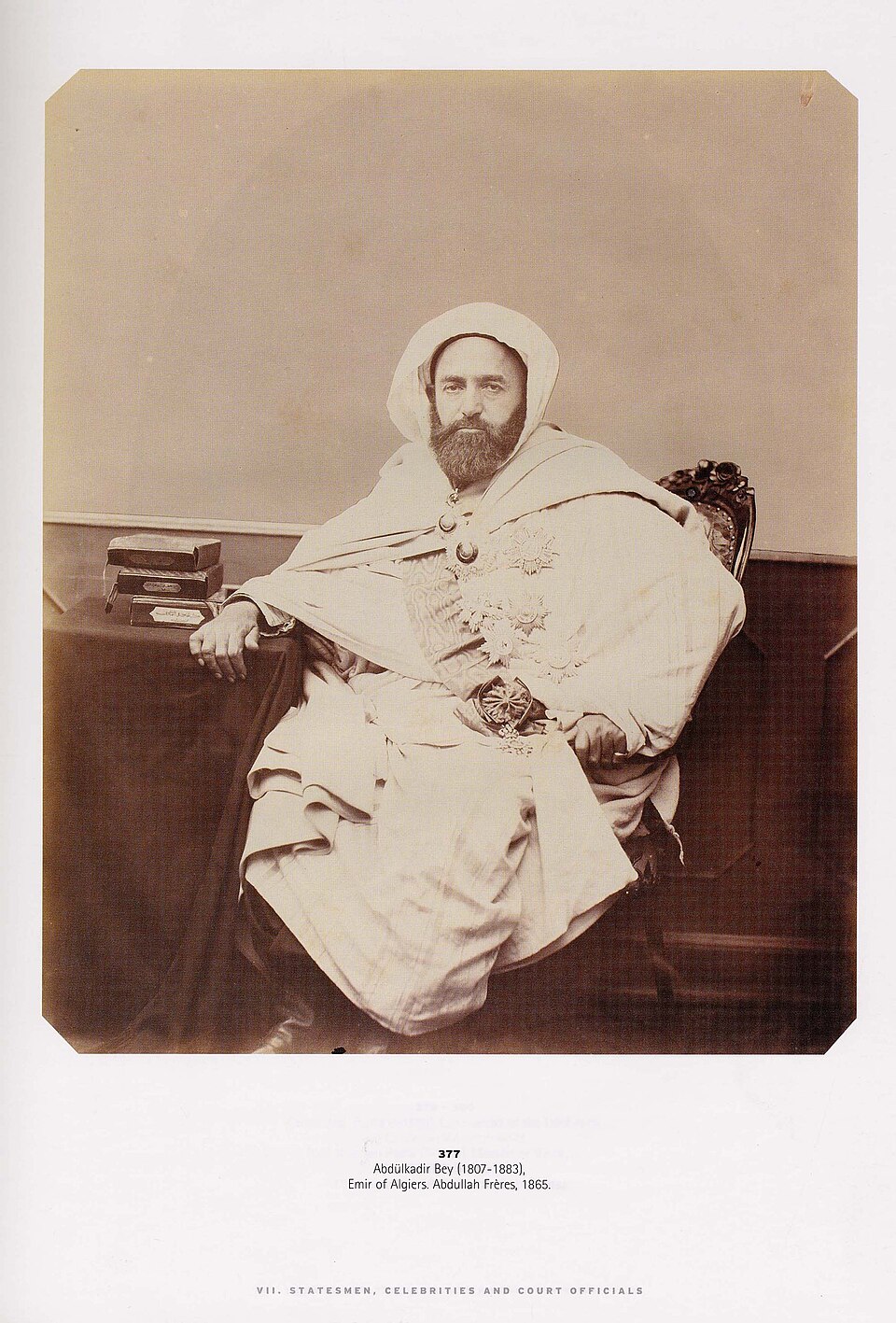
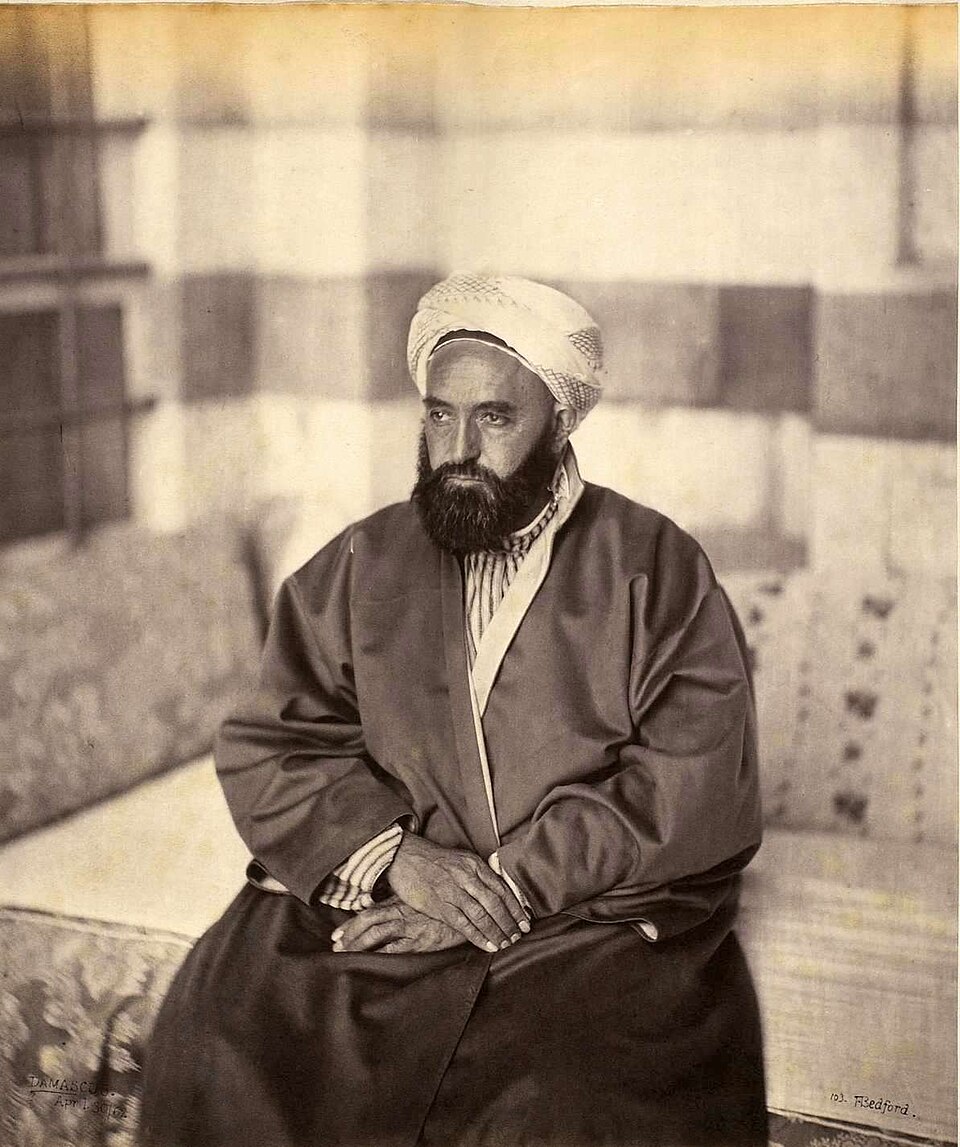
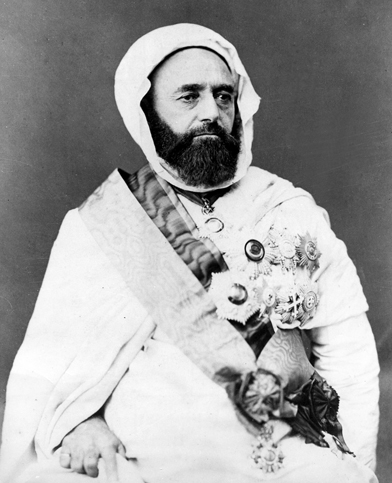
Reported events
Rescue of the Christians of Damascus, 1860
During the massacre of 9 to 15 July 1860 he and his Algerians went through the burning quarter calling Christians out, took them to his house and to the citadel, and reportedly turned aside armed Druzes.
entertaining, as I do, deep feelings of admiration at having witnessed your Highness's exertions in favour of so many persecuted people.
saved from the ruins several hundreds before the Pasha thought of doing so
Reported by Consul James Brant, an eyewitness; French consul Lanusse; Lord John Russell and Lord Palmerston in Parliament; Churchill, from eyewitnesses. Recorded Despatches from July and August 1860.
This is not a miracle claim, and the core event is firmly established by independent officials. Numbers vary widely: the first despatch read in Parliament said several hundreds, while later writers say thousands. Churchill's detail about the citadel and the Druzes comes from a strong admirer. Some Damascene Muslims resented him afterwards, and a French consul had called him poorly regarded there in 1856.
The rescue is recorded by British and French officials in despatches written that summer, one of them an eyewitness. Only the numbers and Churchill's added details are soft. Reviewer's judgment, not a calculation.
Sources: Correspondence relating to the Affairs of Syria, 1860-61 [2800]; Abd-el-Kader: Question, HC Deb 6 August 1860, vol. 160, cc. 696-7; Question, HC Deb 25 August 1860, vol. 160, c. 1815; The Life of Abdel Kader, Ex-Sultan of the Arabs of Algeria; Written from His Own Dictation
Dream of the key at Baghdad
Stories said signs of his greatness were given at Baghdad. Churchill, writing from his dictation, calls them without foundation but says that his father dreamed an angelic being gave him a key and told him to hurry back to Oran.
Many stories have been circulated about mysterious indications given to Abdel Kader, while at Bagdad, of his future greatness. They are all without foundation.
Reported by Abd al-Qadir to Churchill. Recorded Told in the 1850s and printed 1867, about thirty-five years after the event.
A rare case of the subject himself cutting back the legend. French biographers repeated grander versions. A later report of what his father dreamed cannot be tested.
Event scored: that his father had this dream. It comes from the Emir himself, by dictation, some thirty-five years later, and no one else could report it. Reviewer's judgment, not a calculation.
Sources: The Life of Abdel Kader, Ex-Sultan of the Arabs of Algeria; Written from His Own Dictation
His grandfather's wonders on the way to Baghdad
Churchill records family belief that his grandfather Mustafa, lost near Damascus and short of money, received help from a stranger who put coins in his hand and vanished, as a favour from Abd al-Qadir al-Gilani.
My trust was in God alone.
Reported by Family tradition, through the Emir, to Churchill. Recorded 1867; date of the event unknown.
Churchill gives this as belief. An unknown helper is an ordinary event. The Emir, when asked, gave no endorsement and only pointed to God.
A family story with no date and no witness beyond the family, and the Emir would not endorse it. A generous stranger is ordinary, so the weak score reflects the record, not the physics. Reviewer's judgment, not a calculation.
Sources: The Life of Abdel Kader, Ex-Sultan of the Arabs of Algeria; Written from His Own Dictation
Mystical states in the Book of Stops
The Kitab al-Mawaqif presents first-person states of union and of being taught by God, and is credited to him. Bouyerdene's volume places one such state of effacement around July 1860.
Reported by Abd al-Qadir, in the Mawaqif, recorded by students. Recorded In his last decades; printed only after his death.
His Sufi teaching is attested by his circle, but the attribution of the Mawaqif has been denied by his descendants Badia and Khaldun. Scholars in the Bouyerdene volume reject that denial, and the IFAO review calls the question controversial. The manuscript annotated by him is reported in the Musée national de l'armée, Algiers. He himself warned that miracles can be a trap.
Event scored: that he had these contemplative states, as an experience. His circle attests them, but the text was printed after his death and his descendants dispute the attribution. Reviewer's judgment, not a calculation.
Sources: Abd el-Kader, un spirituel dans la modernité; Kitab al-Mawaqif (Le Livre des Haltes), tome 1
Disputes
- On 24 April 1846 about 280 French prisoners held at his deira in Morocco were killed by order of his lieutenant Mustafa ibn Thami, says Churchill, who calls the Emir guiltless. Ten officers were spared. Churchill was an admirer, and French accounts of 1846 were not surveyed here.
- His war included raids on tribes refusing him, and the 1838 siege of the Tijani stronghold at Ayn Madi. Churchill tells this from the Emir's side.
- His initiation into Freemasonry on 18 June 1864 at the Lodge of the Pyramids, Alexandria, for the Paris lodge Henri IV is reported in the Masonic press. Mouloud Kebache's chapter shows that Algerian writers have often denied or minimized it.
- Attribution of the Kitab al-Mawaqif is disputed, as noted under the claim.
- France broke its surrender terms by holding him from 1847 to 1852. He later accepted French honours, and Bouyerdene's volume discusses how France and the Ottomans contested his role in Syria.
- Churchill's explanation of 1860 as a Turco-Druze plot is his own. Fuad Pasha told Consul Brant no conspiracy had been proved, though Brant reported a general understanding among city leaders, and quoted the Emir as agreeing.
Still unknown
- How many people he saved. Figures range from several hundred to many thousands. The French consular registers at Nantes and Brant's Foreign Office despatches (FO 78, FO 195) would allow a count.
- The Légion d'honneur file for the Grand Cross of 1860 was not located, and may not be in the Léonore database under his name.
- His exact birth date. Churchill gives May 1807; other works give 1808.
- Whether he ever repudiated Freemasonry. Bouyerdene's volume treats a later rupture as possible. Grand Orient archives in Paris may help.
Records
Sources
primary
contemporary
scholarly